I retired at the start of 2021, aged 57, and since then have been exploring my new life with my wife Mandy and two terriers Lulu and Ziggy. We own a narrowboat and spend much of the year travelling the canals of the UK. I also enjoy cooking, skiing, visiting new places, and blogging. I love people following my stories.
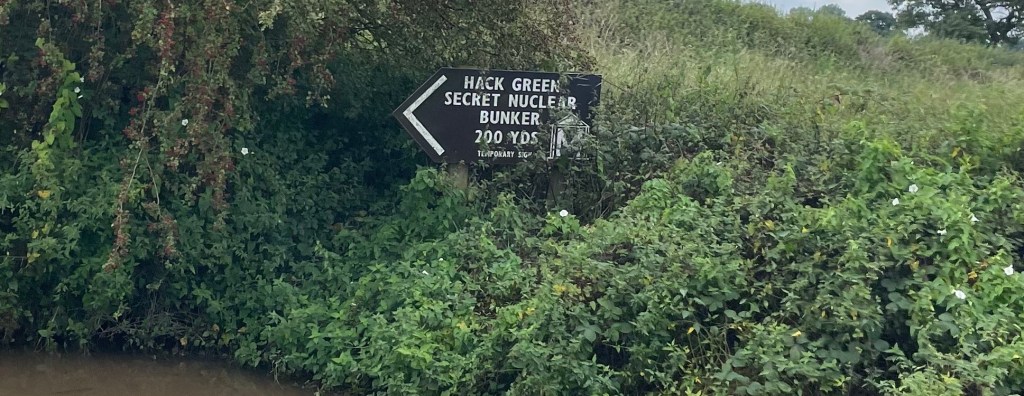
One thing you definitely do not expect to see when cruising the canals is to find a sign for a secret bunker. But that is exactly what I found this week at Hack Green.
I have previously visited a “secret” bunker near St Andrews in Scotland so it was not entirely new to me, but the chance to explore from the canal was too good to miss, and we moored up.
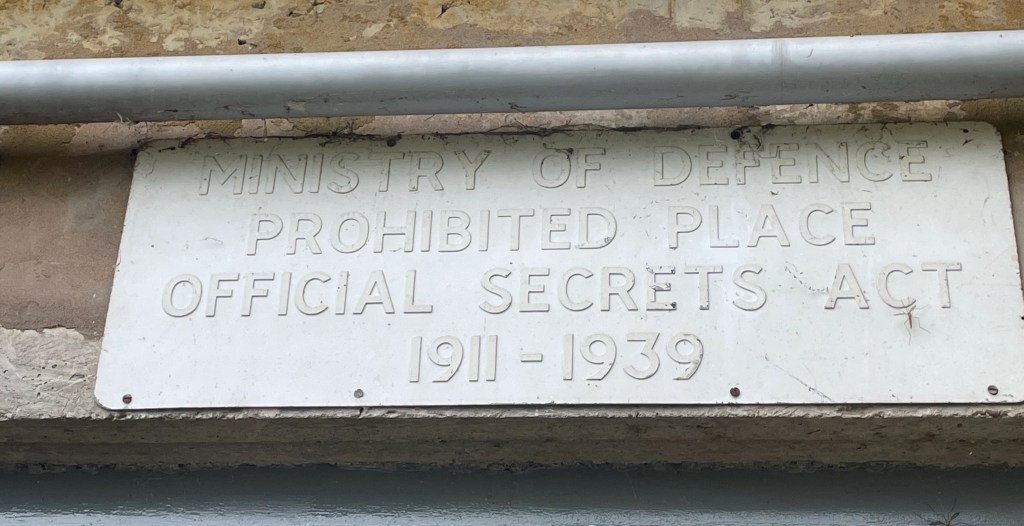
I was born in 1964 and grew up at the height of the Cold War. This would have been the centre for organising the UK midlands if there had been a nuclear war. It just looks like a small farm building, but below ground there are extensive rooms that would have coordinated civil defence activities.
I confess I found the visit fascinating but also very sobering. In the 1950s and 60s we came very close to disaster and it could happen again. In one of the rooms they were showing a film called “War Game” about what the aftermath of a nuclear war would have been like, It was horrific.
Back at the boat that afternoon, travelling through our beautiful countryside I was glad I had visited the secret bunker, but more glad that it had never been needed.
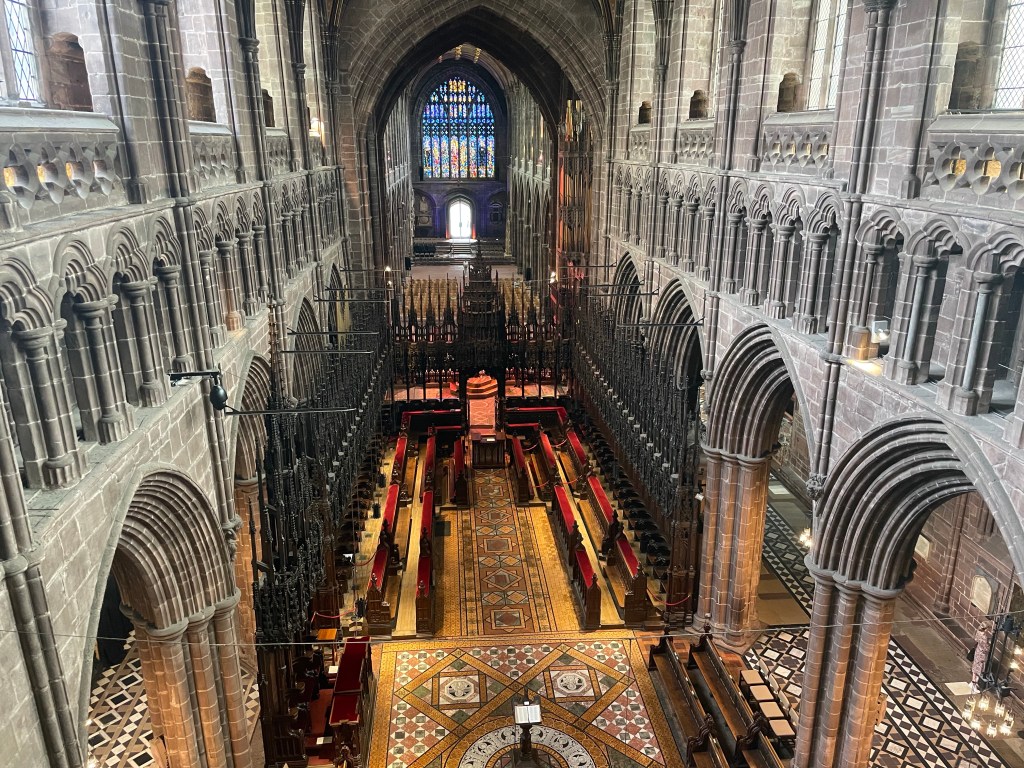
This week we moored the boat in the centre of Chester, a lovely city, dating back to Roman times. We had a spare day so I went on a bit of an exploration. I had never been in Chester Cathedral before so I joined a guided tour, going up the tower and around some of the high up spaces. At around 4pm the Cathedral was quiet and our small group of visitors finished the tour at the very back of the church, above the altar and looking down the chancel and nave as the sun streamed through the stained glass window at the west end.
I am not a particularly religious person but the moment was magical. My father was a Church of England vicar and so I feel very at home in churches. There is a very particular smell of old stone and wood that brings back very happy memories. I am also fascinated by the history. Chester Cathedral was originally an Abbey, built a thousand years ago for a group of Catholic monks. When Henry 8th destroyed most of the monasteries, he kept this one repurposed as a Cathedral for a new diocese in the North West of England.
When I am doing my family tree research, one new discovery often leads to another. Discovering about this Cathedral was the same because when Henry created this new Cathedral, he chose it over an existing one on the other side of Chester, that I simply had to visit.
St John The Baptist’s Church dates back to medieval times, and may even have been built on the site of the Roman Temple to Mythra. There is good evidence that at one time there were three Archbishops in the UK – at York, Canterbury and here in Chester. It is a fascinating place to visit.
I came back to the boat replete with stories of ancient churches to share with Mandy. Lucky her!
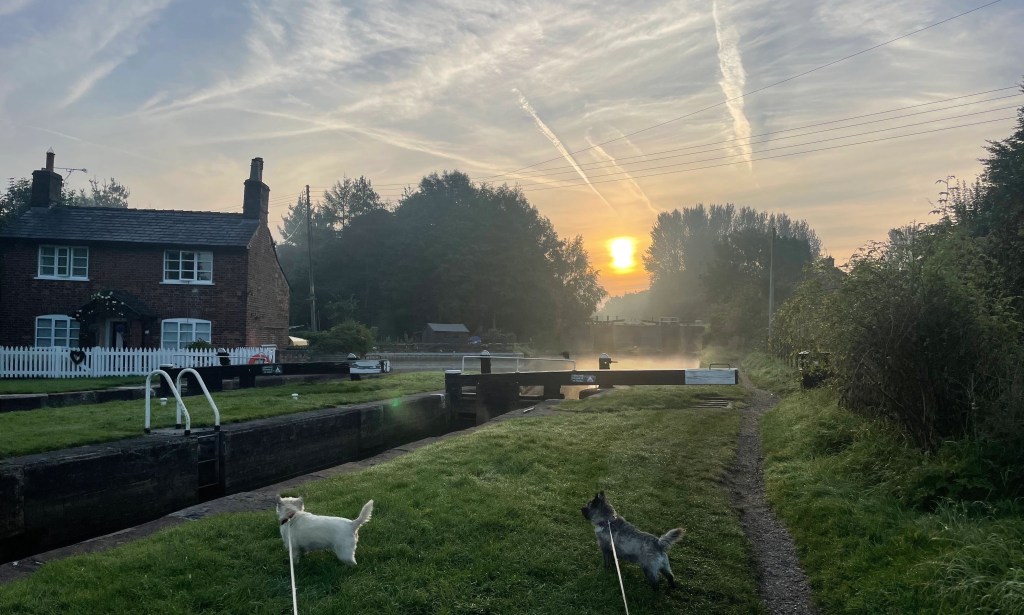
In the UK we have had something of a heatwave this week, with plenty of sunshine and warm temperatures. At the same time the days are getting shorter and I have often woken to mist rising off the canal in the dawn sunshine.
I feel as if such “Indian Summers” are increasingly common, before Autumn sets in, and they provide some of the best days on a narrowboat. The plants are still in full bloom with some just beginning to change colour. The water fowl still have plenty of food and swim happily around the boat. The canals are busy with experienced boaters on hire boats taking advantage of reduced prices after the school holidays. Everyone seems content.
And there are always surprises. On Wednesday evening we were moored outside Chester and went for a bite to eat and a pint in the Cheshire Cat pub, quite a famous boaters’ inn. The food and beer was good and instead of canned music we were treated to songs from a local ukulele band.
They “interpreted” many popular songs. This might sound terrible but after a long hot day on the boat it was genuinely just what I wanted.
We only have a few more weeks cruising this year but right now we are loving every moment. September is a great time to be on a narrowboat.
I am 60 next year. It’s a good age to start reflecting on what I have achieved in my life, and what I want to do with the years in front of me. My standard answer when asked about regrets is that I regret nothing because I have had a great life so far, and if things had been different, I would not have had this life. That is true. Overall I do not regret the choices I have made because I like how it has ended up. I am so lucky to have loved my family, loved my work and now loving my retirement. Travelling the canals of Britain in our narrowboat gives me so many prefect moments.
But to say I have no regrets is disingenuous. There are things in my life that I regret.
I regret not going to Cambridge University. My parents both went and I believe I was academically good enough. I always dreamed about living in an ancient college and taking the advantages that Oxbridge gives you. But if I had gone, I would have missed out on Imperial, experiencing London life, meeting my wife.
I regret not having a gap year. I think if I had done something different before University, I would have been less naive and would have had more world experience as an individual. But I do like the aspect of my character that can’t wait for the next adventure. I rushed into Uni, rushed into work, rushed into marriage, rushed into children. And now I can enjoy early retirement.
I regret leaving Ernst & Young to join Zefer. I was doing well as a Management Consultant, and was dazzled by the bright lights of the late 1990s dotcom boom. The new company failed and I became depressed. But I learnt from the experience, and without it I would not have got the Head of IT role with the Halifax, that I loved and took me to the next stage of my career.
I regret selling our house in Todmorden. Monkroyd is a large Victorian mill owner’s house, set on a Yorkshire hill side. It was the kind of house I dreamt of when I was a kid. Large cellars, hidden rooms in the loft. But if we had not moved, I would not have experienced how wonderful Scotland is, which has been such a great way to spend the last few years.
I regret not getting a CIO role in the Netherlands. We lived in Holland for four years when the kids were little, and after they left home I had the opportunity to return. I flew over for interviews and it just felt right to be back. When they gave the job to someone else I was so disappointed. But if I had been successful I would never have had the chance to spend the last years of my working life with RBS/NatWest, which were probably the most fulfilling roles I ever did.
No doubt there will be things in the next 30 years that I will regret. And rather than thinking that regrets are not useful and to always look forwards, maybe a better choice for me is to recognise those regrets, feel the pain, and then remind myself again how very lucky I am.
When I was growing up there were just two forms of cricket. Test matches between international teams took five days. County matches took three days. Then the big innovation – one day cricket with sixty overs a side. It was treated as “not proper cricket” by the old timers but was more fun to watch and to play. That was that for many years, but in 2008 the India Premier League introduced a new format – 20:20 – in which new city based teams, dressed in colourful outfits, played a league of games over a few weeks, with each game being just 20 overs a side, so a game could be played in an evening. Once again there were many cricket pundits who dismissed the new format as childish, but it took off immediately and has become very successful across the world. The short matches encouraged big hitting from the batters and aggressive bowling.
Then three years ago in the UK, a yet shorter format was developed. “The Hundred” has 20 five ball overs a side – just 100 balls.
The Hundred has been successful for both the men’s and women’s games and is popular with families. On Monday I was lucky enough to be invited by my brother to watch the Oval Invincibles play the Trent Rockets in London., alongside my niece and her husband, and one of my sons.
We were lucky with the weather and both games were exciting with the likely winner changing every few balls, as wickets fell, or boundaries were struck. My brother had brought an excellent picnic and more than a few beers were supped over the afternoon and evening. We got the train home feeling very happy.
Is it as good as a five day test match? It is just different. The test match is more relaxed and more strategic, but oh what fun to watch six after six and amazing catches on the boundary.
And for those that care, the Oval Invincibles won, and will be playing in the men’s final on Sunday. I don’t have tickets but will be watching on TV.
It is definitely harvest time. This week we have travelled through the midlands from Coventry up past Fradley Junction and Great Haywood to Stone – villages that probably mean very little to most people but are famous to narrowboaters, as they were developed around the canals in the 18th Century. The countryside is mostly arable farming – wheat, corn, barley and sweetcorn.
I imagine it has been tricky for the farmers to know when to harvest. As you can see from my picture, taken near Nuneaton, the wheat is full and ready for cutting, but if it is damp, the moisture levels are too high and the price the farmer can get comes down. And the weather has been very mixed this week. One minute it is bright sunshine, the next a heavy rainstorm.
So not surprisingly some days the fields have been empty, and other days every piece of farm equipment has been out. On Saturday we moored up near farmland and were woken about 11pm by the bright lights and noise of a combine harvester and associated tractors. I am not complaining. The farmers have to get the crops in whenever they can.
Living on a narrowboat has brought me closer to nature and how the land is used. You can be steering through an industrial cityscape, and round a corner you find the view opening up over fields to distant hills. This week I saw a kingfisher darting between the bushes alongside the boat. Yesterday evening we were “bothered” by two swans tapping on the side hatch to ask for food. It is not a bad way to spend a summer.
We travelled into Coventry this week. We had been warned that this arm of the Coventry canal can be full of rubbish, but it wasn’t so bad, and it was lovely to be moored in a basin near the centre of town.
I knew very little about Coventry. I knew it was the second city in the UK midlands, and I knew the old cathedral had been destroyed in a German raid in 1940. I had visited it once as a child, and I knew my mother had once had a holiday in Coventry with a young cousin that lived here.
What I had failed to understand was how much the town had been obliterated in the war. After a blitz that lasted about three months at the end of 1940 and the start of 1941, around 75% of all buildings had been destroyed. The Germans used high explosives to take off the roofs of buildings, and then incendiary devices to burn them down. I went to a blitz museum this week and saw footage, with plucky English folk going about their daily lives, surrounded by devastation.
When my Mum went on that holiday in the early 1950s the town would still have been a wreck. Her aunt Dorothy had lived through it and been bombed out of her home twice. Her husband was in the army in India/Burma at the time so Dorothy would have been so scared.
I am aware that the British were equally guilty of such raids, notably Hamburg in 1943. So this is not about who is right and who is wrong. But it is about how tragic the consequences of war are to real people. Coventry is now a vibrant, modern city, but it made me very sad.
The Ashby canal is very beautiful but quite slow. It is fairly shallow and quite narrow in places so we travel at around 2mph most of the time. That is not a particular problem – no point being on a narrowboat if you are in a hurry – but it made the shock even greater when my younger son and I spent the weekend in London at the E-Prix.
Formula E is like Formula 1 but with electric cars. The drivers are world class – often ex Formula 1 drivers, or up and coming youngsters. The cars are largely based on the same chassis and 350kW power units but are built by different manufacturers such as Porsche and Jaguar. They have incredible torque. A modified car, driven by one of the Formula E drivers, got the indoor world speed record last week – 217mph.
And the track in London is very unusual. It is based at the Excel Exhibition centre, inside and outside the exhibition halls. This provides an extra challenge to the drivers, especially when it is raining. The two races at the weekend were the final two of the Formula E year and we saw Jake Dennis, a British driver, win the championship, even though he did not win either race (he was second and third).
We have been to several Formula 1 events in the past. Formula E was more friendly and quite a lot cheaper. I would go again.
So now we are back at the boat. And back to 2mph. 200mph was fun but I am glad to be back.
One of the reasons we love narrowboating is the amazing scenery we see. I do enjoy the old industrial warehouses and mills, but there is something special about finding beautiful countryside with the canal meandering through it.
This week we travelled down the Coventry Canal to join the Ashby, an isolated canal in the midlands. Originally it was used to bring coal from the local mines and was probably filthy, but that industry is long gone and the water is now clear. The countryside is mostly fields with wide views from the boat. It is one of the most beautiful waterways we have travelled.
But perhaps not the most beautiful of all. There are the “curly wurlys” west of Skipton on the Leeds Liverpool. High up in the Pennines and winding around the hills. There are the final few miles of the Caldon to Froghall, in a stunning wooded cutting, with a steam railway for company. There are the Llangollen and the Montgomery, providing a great mixture of winding round the contours of Wales, and cutting through tunnels and over aqueducts. The Sharpness was a revelation for us this year. Straight and wide with great views over to the River Severn. All of these are wonderful but I think the prettiest of all would be the Peak Forest. The Peak District is one of the most dramatic National Parks in the UK, and this canal skirts the edges of high hills, with views for miles.
We are just so lucky to be have the chance in retirement to discover such great countryside.
Do you have a different view of the prettiest waterway in the UK?
In the UK this week there has been a lot of press about Nigel Farage having his Coutts bank account closed. Coutts is a bank for the very wealthy and he does not meet their criteria for how much money he has, but this week it became clear that another reason for closing the account was that the Coutts Reputational Risk Committee did not feel his politics were a fit with the bank’s values. The British newspapers are shouting that it is outrageous that a bank can close an account because they do not agree with the beliefs of a customer. I think they are wrong.
From the Telegraph this week
Before I retired I was a banker with NatWest Group, which includes Coutts. So I have some experience in this area. I also held a senior role at Co-op Bank for a few years, probably the most ethically based bank in the UK, and at Nationwide Building Society, the biggest customer owned bank in the UK. At the time I really noticed the difference in behaviour between these “value based” banks, and the big four – NatWest/RBS, Lloyds, Barclays and HSBC, which were much more focused on profit.
After the banking crisis in 2008, the bailed out banks were left with a terrible reputation, and even now people talk about bankers as being all bad, in the same way they consider politicians, and criminals. To combat this, the big four have repositioned themselves as value based. I remember when the current CEO of NatWest, Dame Alison Rose, was appointed, one of the key reasons was her desire for NatWest to be “purpose led”.
So let’s look at what they say.
Lloyds: “Our purpose if Helping Britain Prosper. We do this by creating a more sustainable and inclusive future for people and businesses, shaping finance as a force for good”.
Barclays: “Our five Values – Respect, Integrity, Service, Excellence and Stewardship – are our moral compass; the fundamentals of who we are and what we believe is right.”
NatWest (including Coutts): “We are guided by our purpose. We champion potential, helping people, families and businesses to thrive.”
HSBC: “Opening up a world of opportunity – helping to create a better world – for our customers, our people, our investors, our communities and the planet we all share.”
I don’t think any of these purposes has really got traction with the public. I am not sure they are aware of them, or believe that banks stand behind them. A customer looking for an ethical bank in the UK will still tend to choose Co-op or a building society.
So instead of Alison Rose apologising to Nigel Farage, as she has done, perhaps she should stand up and say that we do not want to bank customers whose values do not align with ours. What is wrong with that? Perhaps then, people
Don’t worry, next week I will drop the politics and be back to everyday stories of living on a narrowboat.














 Pete's Blog