Well that was nice. We had a wonderful Christmas and New Year. But the festivities are over. The decorations are coming down today. I’m on boring but healthy eating and Dry January. The couple of days of snow have turned into grey rain. Time to start looking forward to this year’s adventures, and that starts with the narrowboat.
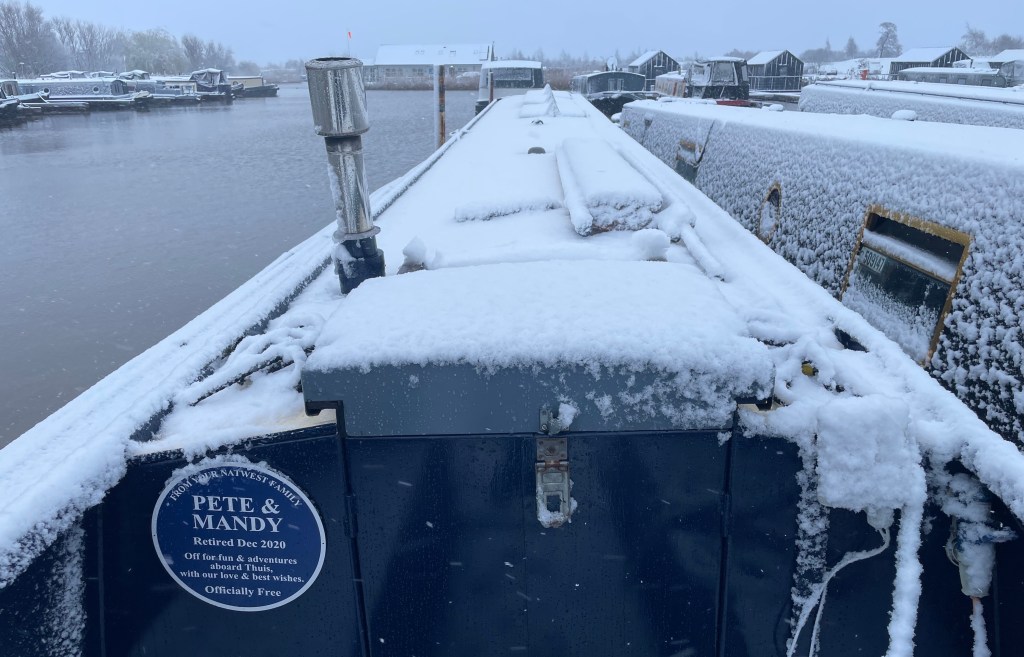
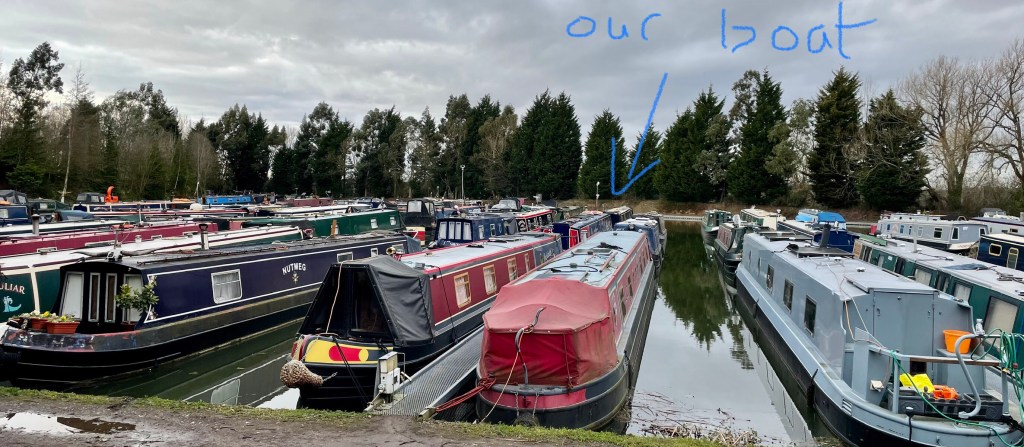
At the moment many of the canals are closed as the Canal and River Trust do their winter works. We probably won’t be able to set off on our long summer trip until March. But we are missing the boat and it is sitting in Staffordshire waiting for us. The engine is serviced, the cooolant replaced, the central heating leak is fixed. The bottom is blacked with bitumen and has new sacrificial anodes. And the roof has ben stripped down and repainted. So it is ready for visitors in its marina.
Next week I plan to go down and get it set up. During the winter we take off linen, crockery, foodstuffs so they need sorting out. The water tank needs bleaching with Milton. The fuel tank needs topping up. The heating systems need checking. And there are some bits and pieces of DIY to do.
Then for Mandy’s birthday towards the end of January, we plan to spend a week or two on the boat. We may not be moving yet, but it will still feel like coming home. There is something about being on a narrowboat that we just find relaxing.
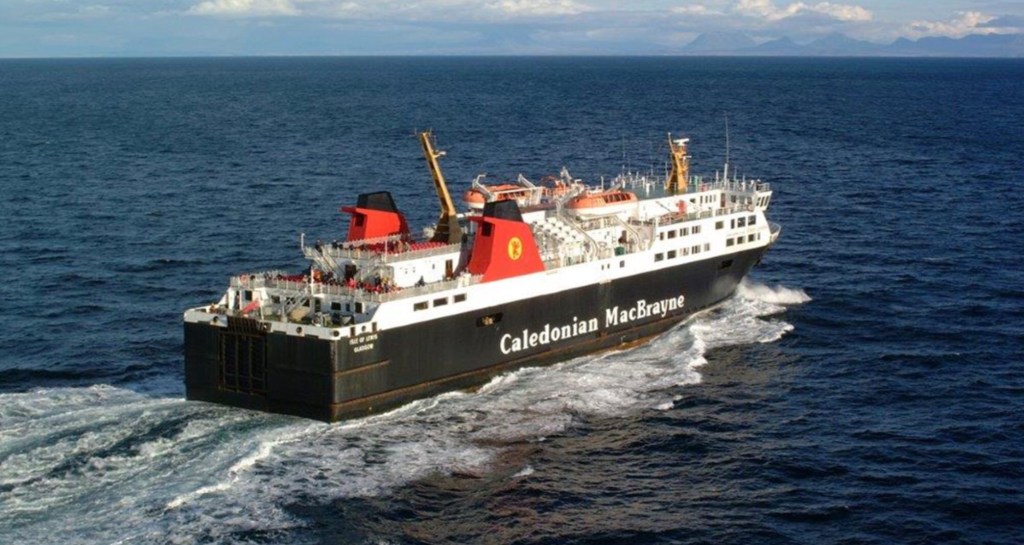
As I write this, storm Babet is arriving in Scotland where I live. It is forecast to bring unprecedented levels of rain, falling onto already saturated ground. When the last storm came, two weeks ago, it broke through part of our roof and through the kitchen ceiling. That has not been fixed yet and so we have buckets at the ready. This time, we are on the edge of an amber warning for rain and wind, and just a few miles away is a red warning, meaning likely loss of life. It would be tempting to hunker down and wait, but on Saturday morning we are planning to drive up to the Isle of Skye to get a ferry across to the Outer Hebrides where we will be living for the next month.
The big question is whether we should postpone for a few days till the weather calms down. The Outer Hebrides are off the Northwest coast of Scotland, and while they have some of the most beautiful beaches in the world, they are also famously wild and windy, exposed to the Atlantic Ocean. The crossing is likely to be pretty bumpy.
There are three reasons I think we should go ahead. We are fairly seasoned travellers. A few years ago we took a ferry across the Bay of Biscay in a storm. Pretty much everyone took to their cabins as the ship rocked from side to side, bow to stern. Even many of the staff were feeling unwell. But my son and I stayed up, had a couple of drinks and watched a Fast and Furious film.
Secondly the ferry company Caledonian MacBrayne has not yet issued a warning on this crossing. Many of the ferries on the east coast of Scotland have already been cancelled but so far, the west is looking rough but passable.
And thirdly it will be an adventure. We spent a month in Orkney a couple of years ago, and one of the things I enjoyed most was watching the weather change from sunshine to storm in the blink of an eye. When we finally get to our cottage this Saturday night, we can light a fire, cook something warming and hunker down.
One thing I am nervous about is whether there will be a storm during our return trip towards the end of November. The port of Uig in Skye will be closed at that point, so instead of a two hour ferry, it will be five hours across the open sea to Ullapool. I am hoping for sunshine.
One question we often get asked by non-boaters is whether we get bored because every day is just the same. The answer is that we never get bored because every day is different. We learn something new each day. We see something new each day. Let’s look at this week as an example.
Last Friday, we travelled from Penkridge to Compton, an unusually long day for us – about seven hours cruising. Despite going through the middle of Wolverhampton in the West Midlands, this is a pretty canal. It is one of the earliest, built by a chap named James Brindley and opened in 1772, and uses the contours of the land rather than cutting through hills and using locks to go up and down. Near Compton I found this pretty Victorian arts and crafts house to visit.
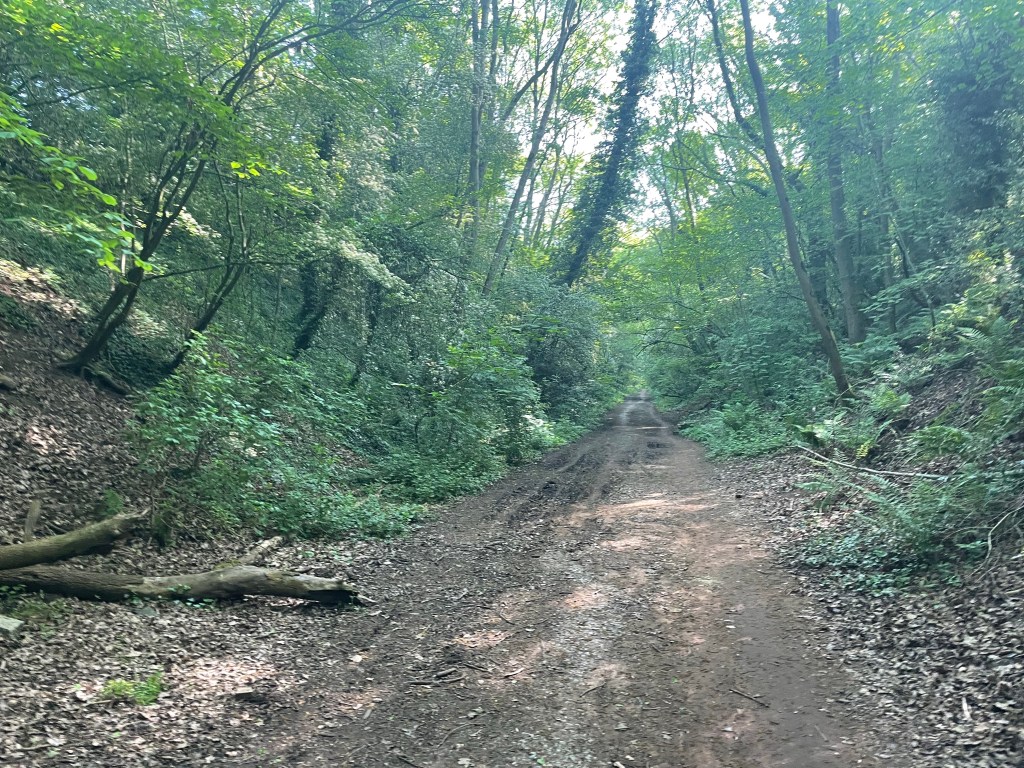
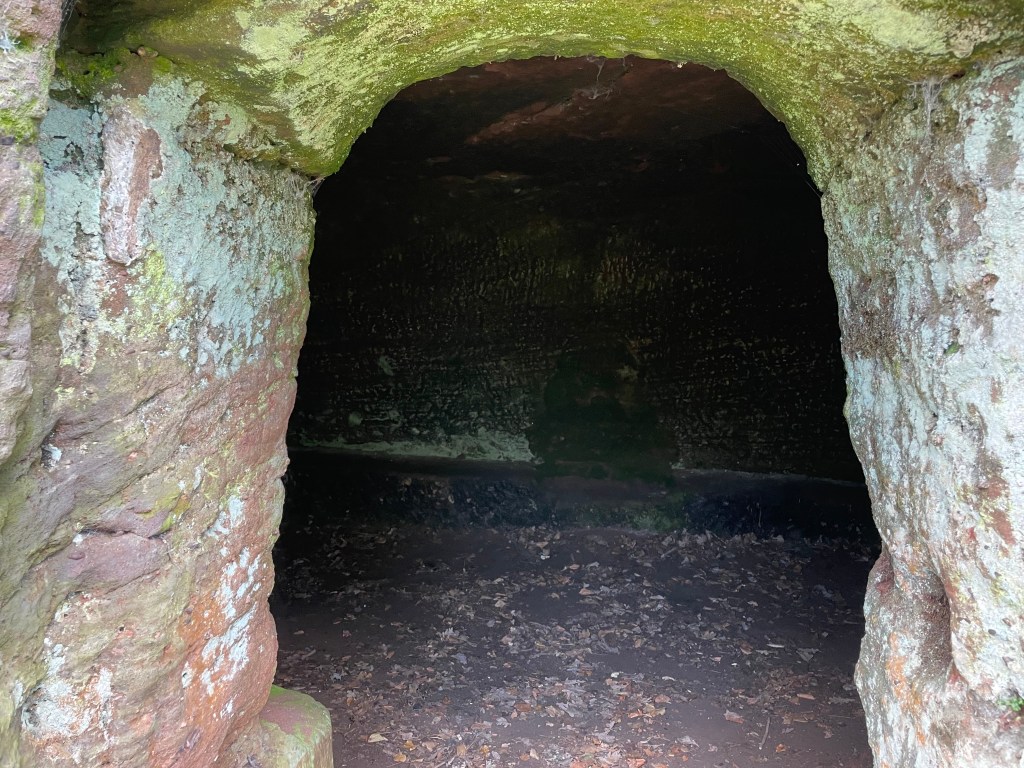
On Saturday, we stayed in Compton for a lazy day. I found a nice long walk for the dogs – along the canal, across countryside and back again along this disused railway line. Fascinating to imagine the heavy steam trains, the grime and dirt. It was a hot day and in the afternoon we found a country park where the dogs could swim. Pizza for team and a film.
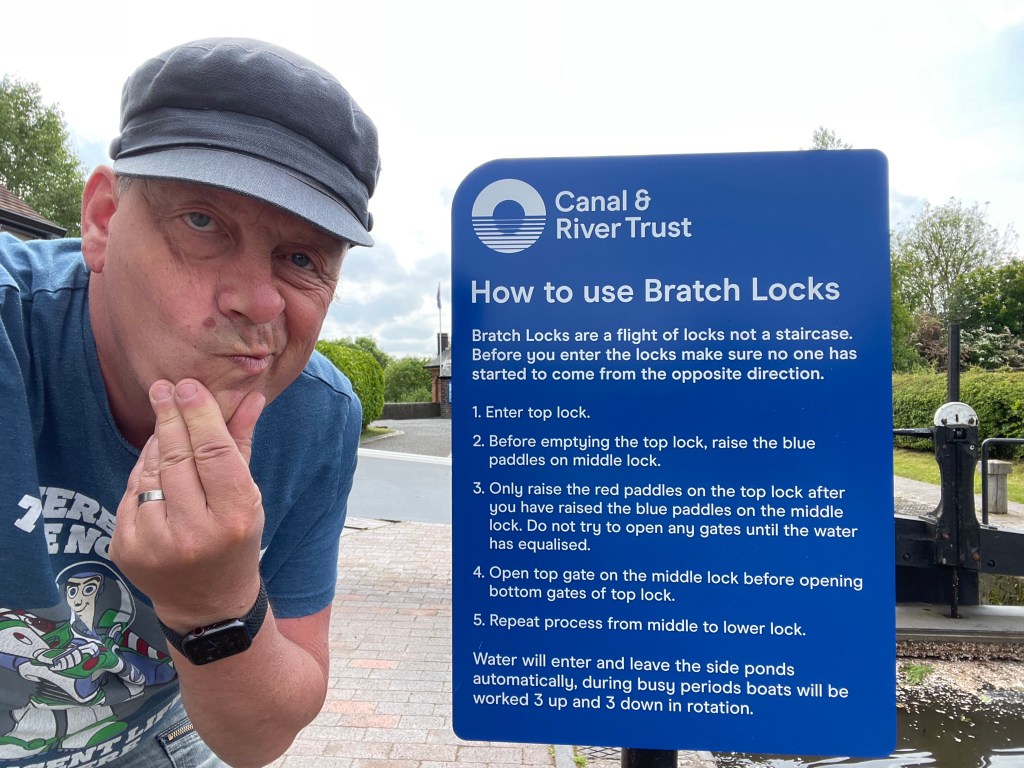
On Sunday, it was back on our journey south. A boat coming the other way warned us that a boat club was ahead of us. Fifteen boats were waiting to go down Bratch Locks. This is a bit of a bottleneck on the canal, because three locks are next to each other, so they allow three boats to go down and then three come up. This means if you are boat four, you will wait around an hour before you can go. If you are boat fifteen, you could be waiting several hours. Fortunately by the time we got there the queue had reduced and we were only held up for around forty minutes. Bratch Locks are fascinating. They were built by Brindley as a staircase, where the top gates of one lock form the bottom gates of the next one. But this used too much water, so around 1820 they were converted to individual locks with about a meter of canal between each lock, and side ponds to hold the water. I have never seen anything like them, and as you can see in the photo, the rules are somewhat complex. Fortunately there were volunteers to help us and all was well.
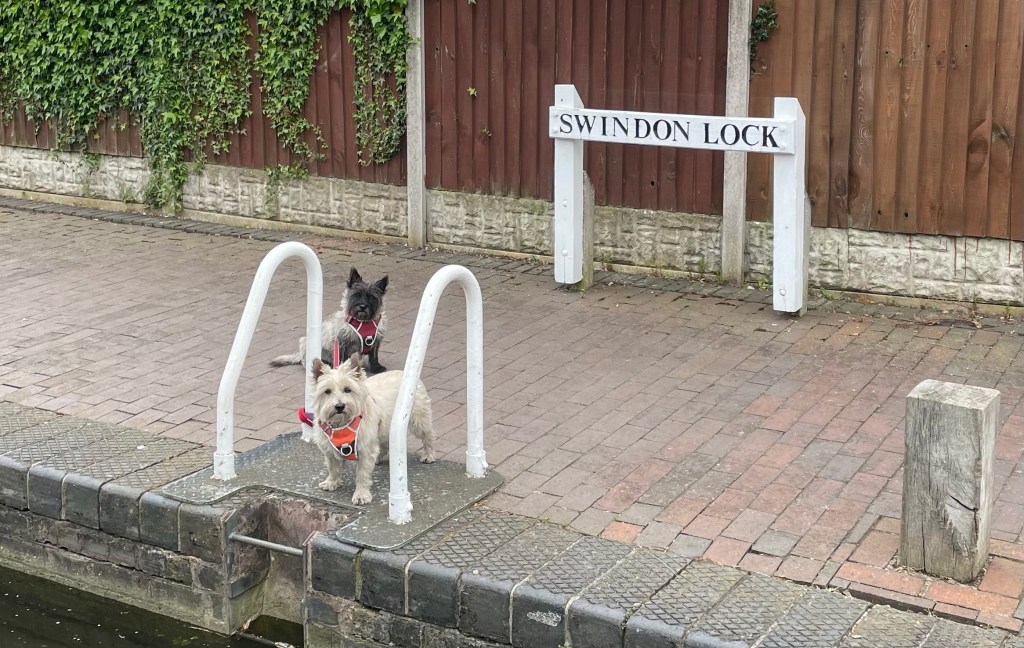
On Monday, we passed through a number of small villages with great names such as Boterham, Giggerty and Bumblehole. We even went through Swindon – not the massive 1960s sprawling town in Wiltshire, but a hamlet of a few houses and a pub in the West Midlands.
Tuesday was a short day. Just a couple of hours from Stewponey to Wolverley. We moored in a beautiful tree lined stretch, next to a brilliant pub called the Lock Inn. It cooked traditional Black Country food. I had a couple of pints of the local ale, and an enormous plate of Faggots and Mash. We considered staying another day, so we could see the Morris dancers, but in the end decided to carry on.
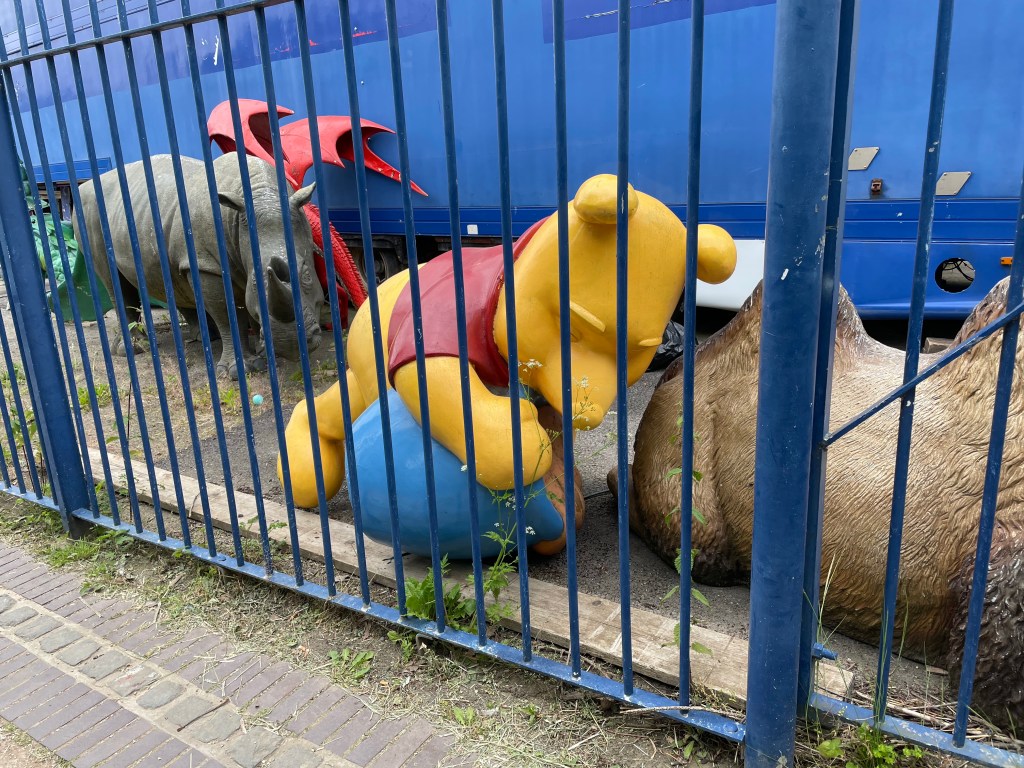
On Wednesday, we continued to the end of the Staffordshire and Worcestershire canal at Stourport. Stourport was once a very small village called Mitton, but after the canal was built became one of the busiest inland ports in Britain, as the canal joins the river Severn and from there large boats sailed down to the sea at Bristol. Nowadays it is a sleepy pretty town, with much history to see. It also has a permanent funfair, where we found this rather sad Winnie the Pooh.
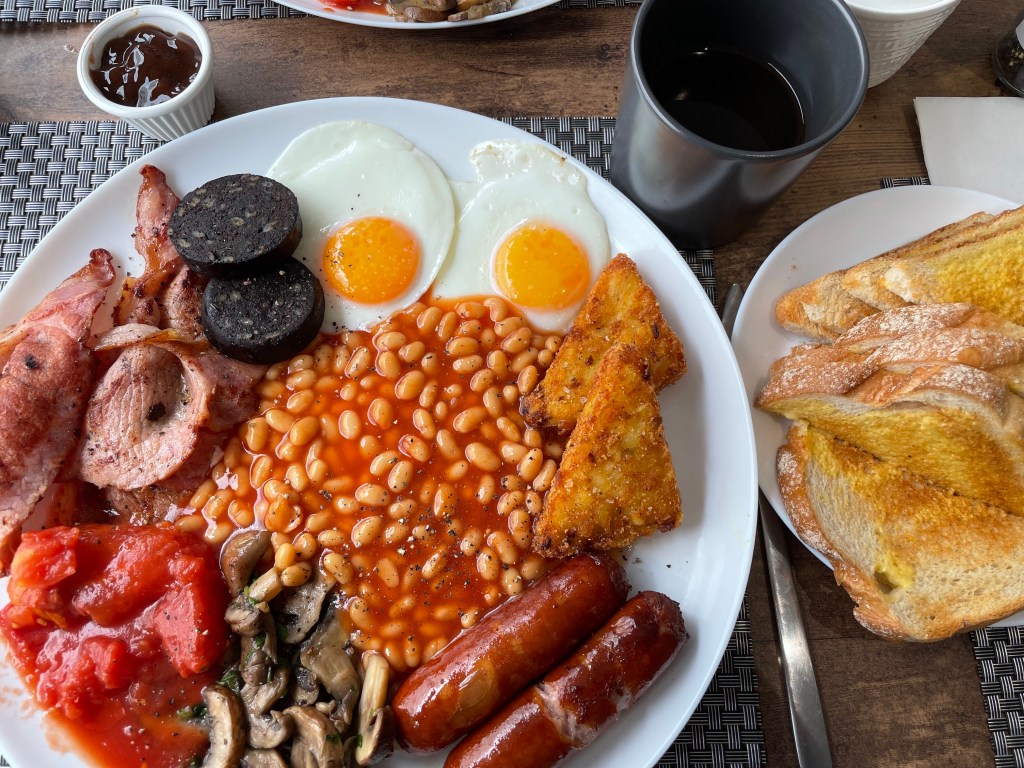
Thursday was another day off and we stayed in Stourport. We took the opportunity to enjoy this small breakfast. Yum! We also went on a trip to see Dudmaston, a huge stately home that is still lived in by a (rather wealthy) family.
So no. Every day is not the same on a narrowboat. Every day brings something new and we are very lucky to enjoy it.
We have had to return to Scotland for a couple of weeks. A few minutes after we crossed the border we saw this sky, welcoming us home with the flag. But in truth Mandy and I are already missing the boat.
Our niece Lucy is getting married so we need someone to look after the dogs while we go to the wedding. We are very excited about their big day and to see all the families but we still want to get back to the boat.
We are also going up to the farm in St Andrews where another niece, Rachael, and her family live. We have not seen two year old Fred for a while, and it is lambing time, and Mandy’s brother and sister in law are there, so we are very much looking forward to that. But we still want to get back to the boat.
While we are in Scotland we have arranged to see the doctor, dentist, get the smart meters fixed, get the dogs hair cut for the summer, get our own hair cut. Some of these are really tricky to do when we are travelling. For instance, a doctor visit is difficult because the Scottish and English National Health Services do not talk to each other. So all important things to do, but we still want to get back to the boat.
I know. We are very privileged and so lucky to have these opportunities. It is important to love every day and not just wish for the future. And I do. It will be a wonderful wedding, excellent to see Fred and all. I am even excited about the smart meters!
It has been convenient to live in a house over winter. Easy to keep clean. Things don’t break as often. Plenty of space. But I have missed the boat.
The new kitchen was finally finished on Tuesday, so I drove down Wednesday with a car full of everything we need for a season – clothes, towels, crockery, cutlery, bedding. I am very pleased with the work the boat yard have done and they have kept the boat relatively tidy. Last year I had to clean lots of mould from surfaces. But this year a quick steam clean of the floor, a wipe of the insides of the cupboards, and we are fine. I have learnt that the key is to allow plenty of air circulation, so moving the bed away from the wall, having several windows open a little, and giving everything a good clean before we leave the boat in the autumn. All these things have helped.
I’m heading back to Scotland later, and then will return with Mandy and the dogs over the weekend. My plan was to get going early next week, with our first trip on the Lllangollen and Montgomery canals through Wales. But the forecast is that the current snow and sleet will continue all week, so I will have to do some pretty fancy negotiating to persuade Mandy that it is better to travel than to hunker down with the cozy stove in the boat.
Gongoozlers (people who like to watch the boats but don’t have one) often ask me if it is cold living on a narrowboat. You might think so because there is just a single metal skin and little insulation. But in fact they are very easy to keep warm and do not use much energy because there is such a small airspace inside. As I write this, it is lovely to watch the snow falling outside while feeling cozy and warm inside, with the boat very gently rocking in the wind.
But I have a list of jobs to be done. I would like to give the kitchen walls a quick coat of paint to make them look as fresh as the new units for when Mandy arrives.
I was hoping that this week’s blog would be about my return to the narrowboat, after having a new kitchen fitted over winter. I know the washing machine has not yet arrived but that is not urgent, and I really want to get the boat set up for the summer season. Unfortunately I found out on Wednesday that the new cooker is installed but is not yet converted to bottled gas, so I would have no way of making food or boiling a kettle. The limited electricity on a boat means that things like electric kettles and microwaves are rarely used.
The new kitchen – work in progress
I am hoping that on Monday the new “jets” will be installed and I can travel down to the boat on Tuesday. I am bracing myself because I have not been on the boat since November, so something is sure to be broken. But we have plans for travelling the west of England this year, so the sooner I get back, the sooner we can resolve any issues and get going.
Last year we travelled for seven months, all around the South of England. This year we plan a more mixed summer, where we travel for 5-6 weeks and then return to the house for 1-2 weeks before repeating. That way we can keep the house in good order, and still make the most of the boat. It will also help us work around some events this year, such as my niece’s wedding and a weekend at the London E-Prix (Formula 1 for electric cars).
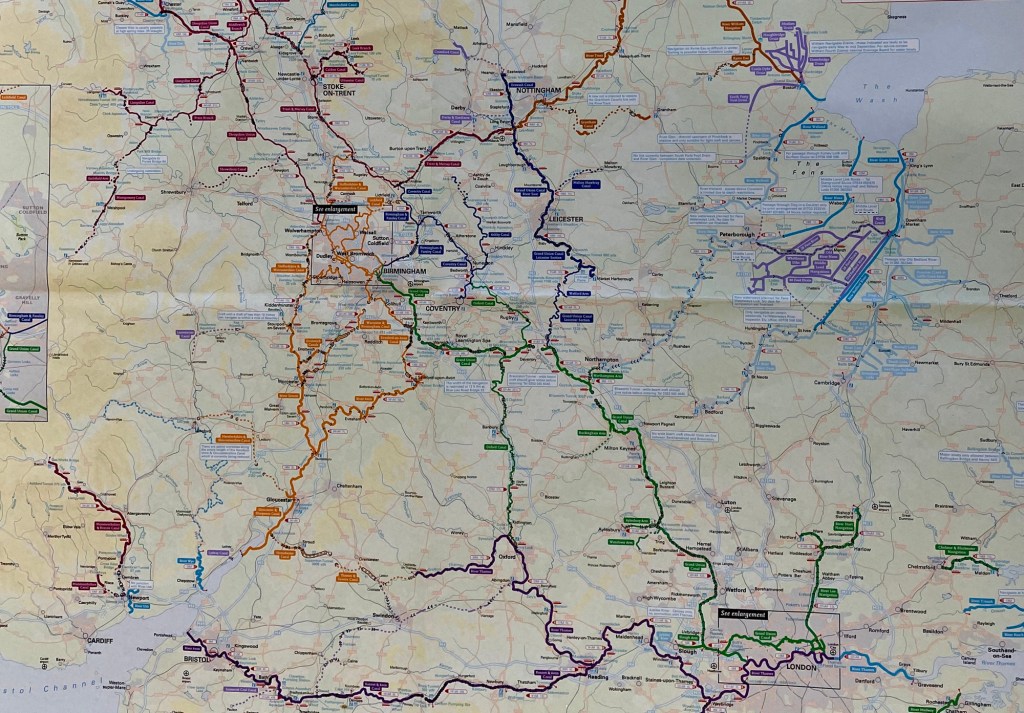
On the boat we also have targets – to spend time around Gloucester docks, to see our younger son in Tewkesbury, to cross the Pontcysyllt Aqueduct and navigate the recently reopened stretch of the Montgomery canal. I also want to return to the boat museum in Ellesmere Port, and possibly to explore the many canals of Birmingham.
So hopefully by next week’s blog I will be back… We will see.
I have just returned from a two week trip to India, seeing many sights across the country and meeting old friends. I enjoyed every moment but I have to say that my favourite few days were in Kochi, Kerala. I have never been to Kerala before, although many people have told me how wonderful it is. Kerala state is the pointy bit at the bottom of India and much of it is made up of jungle and rivers. Trivandrum is the capital but many tourists (like me) go to Kochi instead.
Th lunch we were given after our backwaters trip
I think there are three reasons why I loved it so much – the beauty, the peace and the history.
It is very very beautiful. I went on a backwaters tour, walked around Kochi a lot, frequented the very cheap ferries between the islands, and used quite a few tuk tuks (auto rickshaws). It seemed as if around every corner I would see a fresh “wow” view.
So very lovely
Saying it is peaceful may seem a little odd. The narrow streets of Fort Kochi are as filled with vehicles blaring horns as every other town in India. But get away from the streets, in the Dutch Palace, or the synagogue, or the Cathedral, or in the backwaters, with our boat pushed along by poles rather than an engine. Suddenly everything seems silent and reflective. I even went to a modern art event called Biennale, set in a series of old spice warehouses, and I felt so relaxed just sitting quietly, looking at the exhibits.
Our driverOne of the many exhibits at the Biennale
As for the history, Kochi was one of the first Indian areas visited by western countries. The Roman Empire traded at Muziris, a port believed to be a couple of kilometres north of Kochi. The Dutch, the Portuguese and the English all ruled over the town at one time or another, often working jointly with the local maharaja. Just before Indian independence, a new island – Willingdon – was dredged from the sea, making a port that large ships can now visit, for the trade in spices, particularly pepper. I was able to explore many of these sites. I even popped into Kochi Chamber of Commerce which was near my hotel, and one of the gentlemen there gifted me a copy of a history book celebrating a hundred years of the chamber. India is not just about seeing the famous tourist sites. It is also about exploring and talking to people you meet.
The famous Chinese fishing nets in Kochi.A statue I found hidden in the merchant navy headquarters on Willingdon island.
I was only in Kerala for three days, but I think I have fallen in love. What a magnificent state. And so much more to explore if I ever return.
I am getting excited now as we get nearer to returning to our narrowboat and travelling around the British canals this summer. We have been having work done on the boat including a new kitchen, but that should be ready soon, so hopefully by the end of the month we will be back.
The UK canal and river network is extensive – some 2000 miles – travelling through vast tracts of countryside, and connecting most towns & cities. Before the railways it was the best and fastest way of carrying goods from place to place, and despite falling into disrepair in the first half of the twentieth century, most of the navigations (the official name) are now open to traffic again. Volunteers and the Canal & River Trust keep the waters clear and the locks operating. It is somewhat easier than other countries because most of the equipment is self service and we can take our narrowboat anywhere we like, whenever we like.
Just a few of my guides
So of course that begs the question of how we know where to go. The answer is a mixture between 21st and 19th century technologies. There are some great apps and websites. One of our favourites is “Canal Plan AC” website, which is brilliant at working out how long it will take us to make a journey, and where likely stops are along the way. It takes account of fast and slow navigations, and time to get through locks, as well as how many hours a day we want to travel, and where are good places to moor. The other app on my phone is “Open Canal Map” which allows me to track our journey live and zoom in and out of the canal maps, for instance to see where a water point is, or a recent stoppage.
But I have to admit, despite the advantages of technology, I prefer to use proper paper books. There are two sets of canal books in common use in the UK – the Nicholson Guides and the Pearson Guides. Pearsons are more chatty and have simplified maps. Nicholsons are more comprehensive and have the detailed Ordnance Survey maps. Both guides have been around for over 50 years and are updated every few years. I had always thought that was done by hundreds of editors but by coincidence we have become friends with Jonathan Mosse, who lives on a boat near us in Scotland, and does most of the work to keep Nicholson guides up to date. When he started in the 1970s, he would spend his days boating and cycling along canals. These days he can do a lot of the research online, but he is still always grateful for updates from boaters like ourselves, who travel the canals every day, and can let him know when a bridge number has changed or a pub has closed.
This week, he kindly sent me the guides that have been updated for 2023 – covering the North West of England. They are shiny and new but it will not take long till they are covered in muddy thumb prints and hand marked updates. I feel privileged to play a small part in keeping everyone informed as we share the navigations.
If you have never had a narrowboat holiday in the UK, I recommend it. The slow pace of life will bring mindfulness and calm, even if just for a week. And don’t forget to get a copy of your local guides.
Cruising the canals of England, I have come to the conclusion that there are five kinds of narrowboaters. Of course this is stereotyping. Everyone is different, and one of the things I love about this life is meeting the many people and finding out about their lives. But sometimes stereotypes are useful, so here we go.
Can Hill Locks
The day boaters. This is usually a group who have hired a short boat for the day, and crammed on as many people as they can. Often celebrating a birthday or an event, there is usually a lot of beer and wine consumed, often music, and very little understanding of how to steer a boat, or the rules of the canal. They career from side to side and we try to stay out of their way.
The hire boaters. This is usually a family or friends, who have hired a boat for a few days or for a week or fortnight. Sometimes they also are newbies or sometimes they have had many narrowboat holidays and understand it as well as us. Usually they are keen to learn, and we love to talk to them, to hear what they have been up to and where they are going. Often they are on a mission, perhaps a canal ring to complete, or a place to get to, and they will cruise for eight or more hours a day. Our one complaint about hire boaters is that most of them go too fast, especially past moored boats, sending them rocking in their moorings.
The marina moorers. These are people who keep their boat in a marina and rarely move it. Instead the boat is treated more like a static caravan – somewhere to visit for a holiday, and an occasional trip out. We have a lot of empathy with these people because before I retired, this is exactly what we did, with our boat moored at the Kelpies in Scotland. Marina moorers often form quite a community with other boaters in the marina, and when visitors like us join them, we usually find them welcoming. Bit of a waste of a boat though.
The continuous cruisers who cruise. This is us. The rules of our licence are that we must keep moving every couple of weeks, but in practice, we are on a proper adventure and spend most days moving on to find new places to visit. There are surprisingly few boats doing this, but we get to meet them, and often see them again, on a different canal, later in the year. The problem with this group is that we can be narrowboating snobs. Because we move such a lot, we like to think we are expert boaters, and can be critical of others, especially hire boaters.
The continuous cruisers who don’t cruise. These people have continuous cruising licences, rather than ones for a marina or official long term mooring, but in practice they stay put. I do have sympathy for these people. Often they have very little money, and perhaps children in schools, so can’t move all the time like us. They live in fear of the Canal & River Trust police, who check that boats are moving every two weeks. My only complaint is when they sit on the visitor mornings in the centre of towns, which are meant to be restricted to one or two days.
There are other subgroups I have missed, such as the stag and hen do weekenders, the honeymooners, the people who move boats for a living. Despite any grumbles, we all rub along just fine. And one of the benefits of narrowboating is that if you don’t like the people you are moored next to, then you can just move on. It’s not a bad life.
Back on the boat. Back to problems. When you live on a narrowboat, there are always problems. Always something to fix, always something not quite right. And at the start of a season this is even more true. We have had a lot of work done on the boat over winter and there are snags with the new equipment. And the old equipment has had a winter of frosts and no love, so is playing up.
I am writing this early in the morning after a difficult night when our 240v electricity stopped working, and our water pump would not turn off. The diesel heater will now not come on, and the engine will not start. My fancy new inverter/charger bluetooth app says that the batteries are fine, but the “low battery” light is on and the 240v system will not work. We can’t use the toilet or the taps while the pump is off. Aaaaaargh!
We had planned to set off from the marina this morning, but that won’t be happening till we get fixed. This is where we have to change our attitude back to living on a narrowboat. If we don’t move today, it does not matter. We are retired. We have time. And everything will get fixed. I should count my blessings that we are still in the marina where there are engineers, and we can get work done. And it will be a learning experience. I will find out what broke so that next time I may be able to fix it myself.
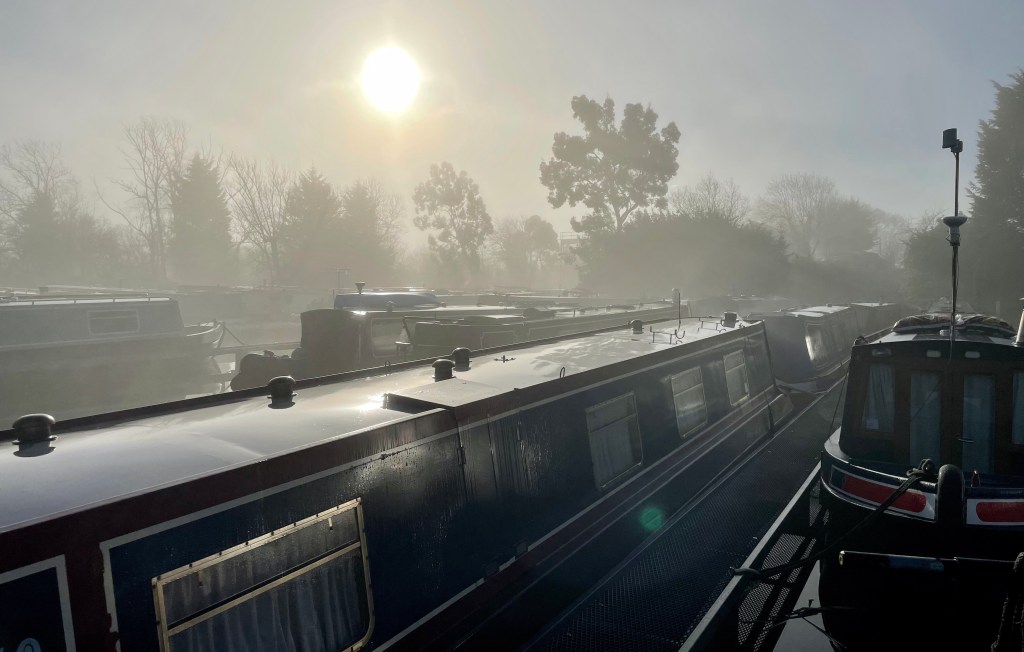
And it is a lovely morning. The sun is bright, and the mist is rising off the water. I think it is going to be a wonderful day.








 Pete's Blog