The weekend before last we visited our eldest son Rob and his fiancée Alessa in their new house in Sussex. We had a lovely few days, eating well, drinking well and seeing the sights. I had not realised how beautiful that area of the country is, with rolling chalks downs and extensive views of the sea. Before we arrived Rob called to ask if we would like to join them at “On the Beach”, a music festival in Brighton. Mandy said she would prefer to stay at home with the dogs but I decided to go. I quite like the bands (The Kooks, Maximo Park, Kate Nash and others) and it sounded like an adventure.
I did enjoy the festival. The music was good, the weather stayed mostly fine and we had a few beers. But I did feel old. I was one of the oldest there and I confess I was glad we sat halfway back instead of pushing forwards into the mosh pit. I was also glad when we left before the last few songs so that we could beat the traffic.
If I had been Rob’s age I would have laughed roundly at such behaviours. What an old fogey! But I think at 60 it is time to embrace old fogeyism. I can enjoy occasions such as On The Beach without having to pretend I am 20 again.
What do you think? Is it good to act my age, or is that the first sign of the downward slope towards senility and death?
We have sold our house, visited our sons, sorted the packing. And now we are back at the boat. The plan was to be back on the move by now. So why are we still moored in Lyme View Marina?
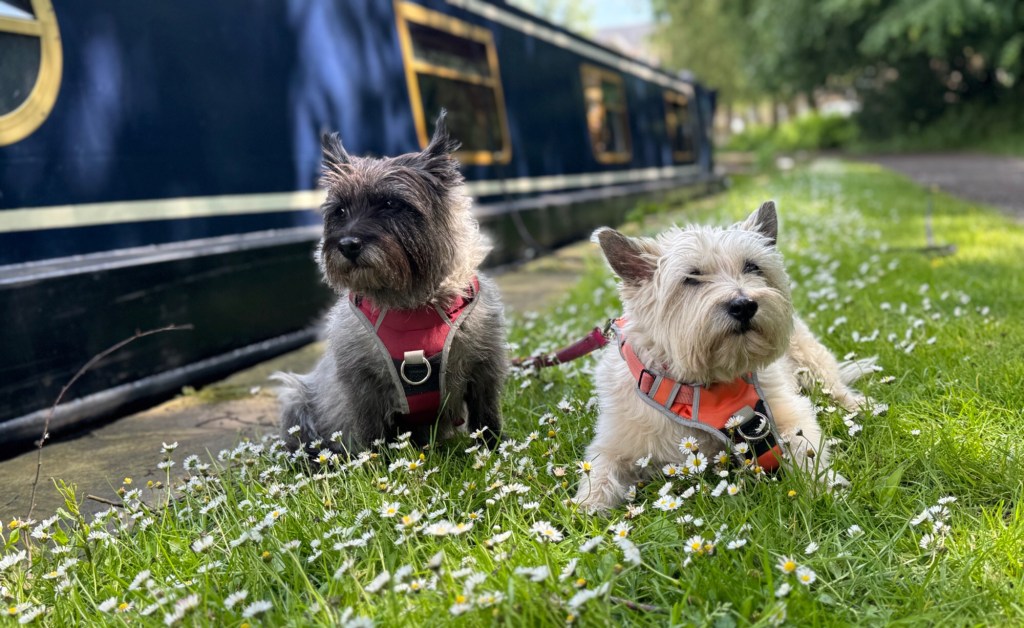
It is all about Ziggy. We have two dogs – Lulu and Ziggy. Last week we took them to the vets to get their teeth cleaned. Lulu was fine but when the vets checked Ziggy’s blood, she was found to have really low sugar levels. Since then she has undergone a number of tests and the vets have ruled out the most common diseases. We have left Scotland because we no longer have a house, but the vet there has called us to say the most likely problem is an insulinoma, a growth on the pancreas.
So rather than setting off on our journeys we have registered with a local vet near Manchester and are waiting for a an ultrasound scan to see what is going on. Ziggy seems fine in herself so hopefully it is not too serious, although the prognosis for insulinoma is not great.
In all honesty I am finding it a little frustrating. I want to be back on “the cut”, cruising the canals. But Ziggy is family and family comes first.
At least this gives us time to do some house hunting and have some adventures. It was not my plan, but sometimes plans have to change. Apparently.
By the time this blog is published, we will be houseless. After nearly two years on the market our house in Scotland should complete its sale today and will have new owners – a lovely family who will get to enjoy the history of this nineteenth century farmhouse which became swallowed by a new town in the shale oil revolution around 1900.
I deliberately use the word “houseless” not “homeless” because we still have a home on our narrowboat. Dictionaries define “home” as simply the house where you live, but I think it means more. You know you are home when you sit down with a happy sigh. It is the place where you feel most comfortable and most safe. So much more than a house.
And when we arrived back at the boat last night we immediately felt at home. It just feels so right to be here. Putting all our stuff into storage this week has been pretty stressful. It has also reminded me how over the years we have collected things that we really don’t need. We are no happier in a house surrounded by chattels than we are in the boat where we have very little.
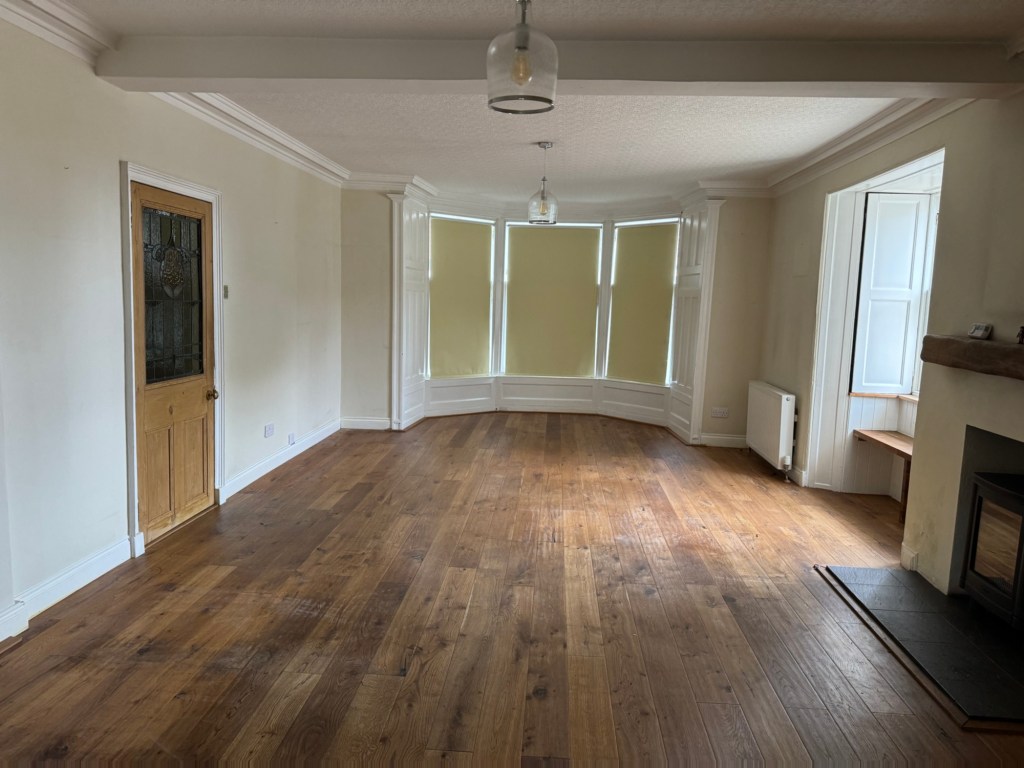
We do still want a house as a base for winters, and for the future when we can no longer operate locks or moveable bridges. Next week we will be staying with our eldest son and his fiancée near Brighton. We are looking forward to seeing them and their new home. And when we then return to the boat, we will properly start our house hunt.
But for now it is great to be home on Narrowboat Thuis. Entirely appropriately “Thuis” is Dutch for “home”.
I have written before that one of my hobbies is researching my family tree. This week I received a pack of old photographs from one of my Mum’s cousins. He has been tidying his house and knew that I am interested in the family, so sent them to me. He kindly annotated the backs of the pictures when he knew who they were, but this photograph was blank.
Most of the pictures are from the family of a man called John Davies, a distant cousin who was a chaplain serving in the Royal Navy, I knew the navy had chaplains but did not realise that they sailed on the ships for many months, just like ordinary sailors. John also served on submarines where he said that the confined space led to depression and need of a chaplain.
There were also photographs and newspaper articles about John’s relations. His father and grandfather were also priests, working in a small area of Wales. His grandmother was a very posh looking woman called Dorothy Jebb. She is my great great aunt and came from a very wealthy family.
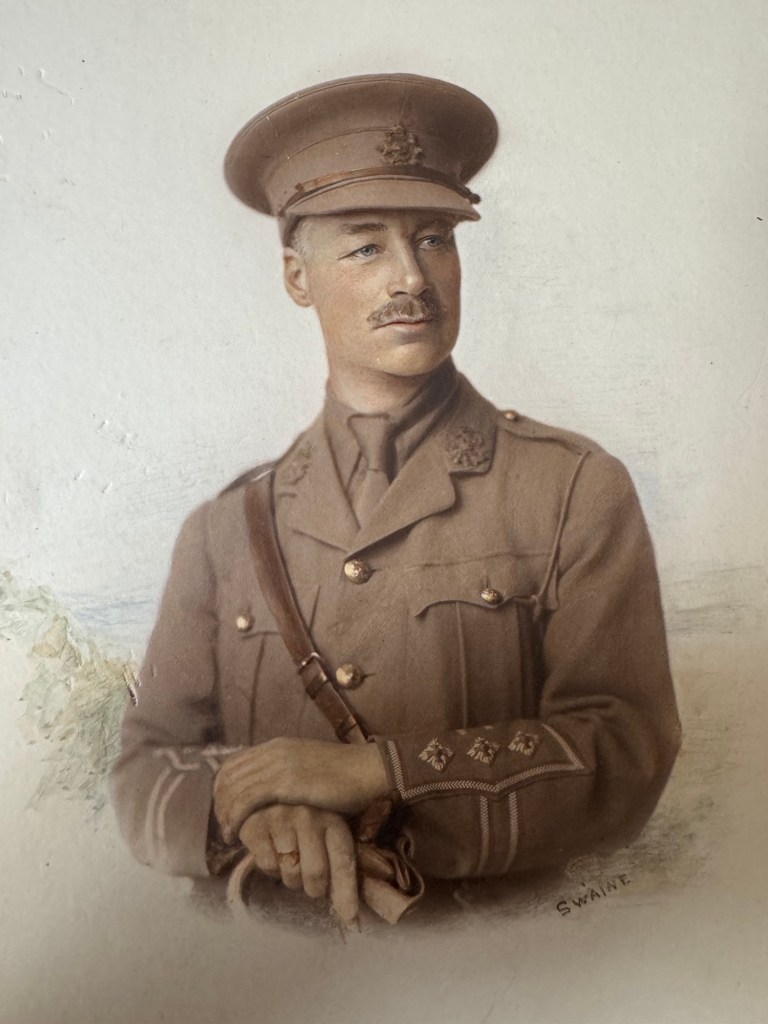
But I am still stuck on this photograph. He looks a very smart soldier, I am guessing from the First World War. With three crosses on his wrist, perhaps he was a captain? John and his father both had low eyebrows, so it is not them.
In future times perhaps AI will allow me to search this photograph and find who it was, but for now I think it is sad that such a photograph, maybe made for a mother or sweetheart, cannot be identified. I will raise a glass to him.
I remember I loved being ten. My dad took me to London and we went around the science and natural history museums. I wanted to be grown up.
Being twenty was even better. I was at Imperial College (near those museums by coincidence). I was station manager of the university radio station and was sure my future lay in the BBC. I felt very grown up.
My thirtieth birthday was in the Netherlands. I was working in IT for a company called Logica. We were about to return to the UK after a four year secondment. It had been an amazing adventure, living abroad, learning a new language and a different culture. I was married to Mandy and we had two boys, then aged four and five. I was definitely grown up.
I did not like my fortieth. We were living in Yorkshire and I was working for the Halifax Bank of Scotland. I loved my job and my family but I did not like the idea of being forty. In my head I was in my thirties. I had a convertible BMW to prove it! I might be grown up but I still felt young.
Fifty was a much better birthday. Work was a bit tricky since I was between roles, but the boys had left home and with Mandy we were enjoying our prime. I felt very happily middle aged.
Sixty is even better. I love having a bus pass and getting discounts. Life as a retiree is better than I could have imagined. And I am still fit enough to do the things I always wanted, such as living on a narrowboat and spending a month interrailing. I may be old but I am certainly not grown up.
We have had a wonderful Christmas week. Far too much to eat and drink. Thoughtful gifts. Wonderful company. Competitive games. An unexpectedly busy Midnight Mass. A glamorous hotel. A hideaway cottage. An apartment minutes from the beach. And most of all – family.
Christmas Day is my favourite day of the year. I hardly sleep in the week before because I am so full of excitement. It harks back to my childhood when Christmas was such a magical time. And then when our two boys were little and the anticipation and delight n their eyes. Sometimes the reality of Christmas is a let down, but sometimes like this year it is every bit as good as I had hoped.
So why am I so tired?
I have not worked very hard. Others have taken on the heavy lifting of cooking, planning, entertaining. It has been fun. But the truth is that all of us, including the dogs, now just want to sit in front of the TV and snooze.
Maybe that is how Christmas should be. Full on, and then sleep.
I am 60 next year. It’s a good age to start reflecting on what I have achieved in my life, and what I want to do with the years in front of me. My standard answer when asked about regrets is that I regret nothing because I have had a great life so far, and if things had been different, I would not have had this life. That is true. Overall I do not regret the choices I have made because I like how it has ended up. I am so lucky to have loved my family, loved my work and now loving my retirement. Travelling the canals of Britain in our narrowboat gives me so many prefect moments.
But to say I have no regrets is disingenuous. There are things in my life that I regret.
I regret not going to Cambridge University. My parents both went and I believe I was academically good enough. I always dreamed about living in an ancient college and taking the advantages that Oxbridge gives you. But if I had gone, I would have missed out on Imperial, experiencing London life, meeting my wife.
I regret not having a gap year. I think if I had done something different before University, I would have been less naive and would have had more world experience as an individual. But I do like the aspect of my character that can’t wait for the next adventure. I rushed into Uni, rushed into work, rushed into marriage, rushed into children. And now I can enjoy early retirement.
I regret leaving Ernst & Young to join Zefer. I was doing well as a Management Consultant, and was dazzled by the bright lights of the late 1990s dotcom boom. The new company failed and I became depressed. But I learnt from the experience, and without it I would not have got the Head of IT role with the Halifax, that I loved and took me to the next stage of my career.
I regret selling our house in Todmorden. Monkroyd is a large Victorian mill owner’s house, set on a Yorkshire hill side. It was the kind of house I dreamt of when I was a kid. Large cellars, hidden rooms in the loft. But if we had not moved, I would not have experienced how wonderful Scotland is, which has been such a great way to spend the last few years.
I regret not getting a CIO role in the Netherlands. We lived in Holland for four years when the kids were little, and after they left home I had the opportunity to return. I flew over for interviews and it just felt right to be back. When they gave the job to someone else I was so disappointed. But if I had been successful I would never have had the chance to spend the last years of my working life with RBS/NatWest, which were probably the most fulfilling roles I ever did.
No doubt there will be things in the next 30 years that I will regret. And rather than thinking that regrets are not useful and to always look forwards, maybe a better choice for me is to recognise those regrets, feel the pain, and then remind myself again how very lucky I am.
When I was growing up there were just two forms of cricket. Test matches between international teams took five days. County matches took three days. Then the big innovation – one day cricket with sixty overs a side. It was treated as “not proper cricket” by the old timers but was more fun to watch and to play. That was that for many years, but in 2008 the India Premier League introduced a new format – 20:20 – in which new city based teams, dressed in colourful outfits, played a league of games over a few weeks, with each game being just 20 overs a side, so a game could be played in an evening. Once again there were many cricket pundits who dismissed the new format as childish, but it took off immediately and has become very successful across the world. The short matches encouraged big hitting from the batters and aggressive bowling.
Then three years ago in the UK, a yet shorter format was developed. “The Hundred” has 20 five ball overs a side – just 100 balls.
The Hundred has been successful for both the men’s and women’s games and is popular with families. On Monday I was lucky enough to be invited by my brother to watch the Oval Invincibles play the Trent Rockets in London., alongside my niece and her husband, and one of my sons.
We were lucky with the weather and both games were exciting with the likely winner changing every few balls, as wickets fell, or boundaries were struck. My brother had brought an excellent picnic and more than a few beers were supped over the afternoon and evening. We got the train home feeling very happy.
Is it as good as a five day test match? It is just different. The test match is more relaxed and more strategic, but oh what fun to watch six after six and amazing catches on the boundary.
And for those that care, the Oval Invincibles won, and will be playing in the men’s final on Sunday. I don’t have tickets but will be watching on TV.
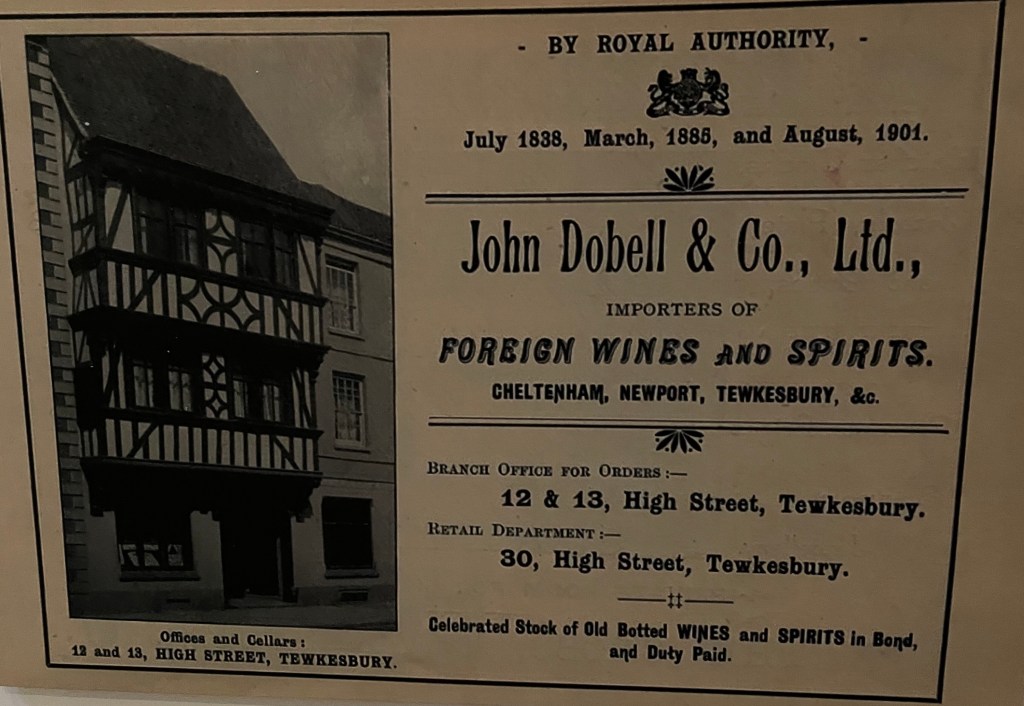
I was wandering around Tewkesbury Abbey late on Saturday afternoon. It is a beautiful church and the sunlight streamed through the stained glass windows, painting pictures of the floor. In one of the side aisles they had an exhibition of pictures of the high street last century. One of the pictures was this:
It gave me a bit of a shock because John Dobell was my great great great grandfather. He had a fascinating life, coming from poverty in Cranbrook, Kent. As a teenager he became apprenticed to a wine merchant in London called Samuel Thompson. John fell in love with Samuel’s daughter Julietta. Samuel was a radical Protestant preacher, and when John and Julietta married in a church, Samuel stood up and denounced the ceremony. I am guessing there was a falling out because John and Julietta moved to Cheltenham, and over the next years, built their own business, based in Cheltenham and Tewkesbury.
They became very wealthy, and that money was passed down the generations. Even my Grannie was brought up with servants in big houses. Unfortunately the money all went, and the Dobell family trust was finally wound up around 1995. The remaining funds were split amongst the youngest generation. I think my two sons got about £200 each.
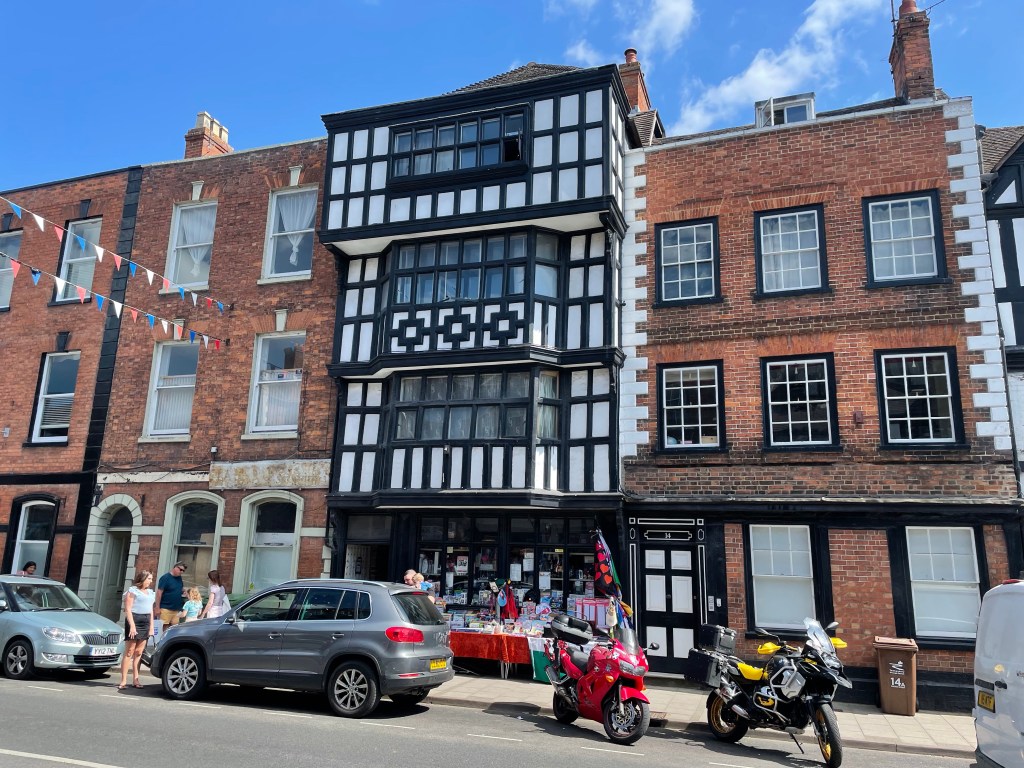
Still, it is interesting to think about what the Dobells’ life would have been like. The shop in the advert is still there, although no longer a wine merchant:
I was wandering around Tewkesbury Abbey late on Saturday afternoon. It is a beautiful church and the sunlight streamed through the stained glass windows, painting pictures of the floor. In one of the side aisles they had an exhibition of pictures of the high street last century. One of the pictures was this:
It gave me a bit of a shock because John Dobell was my great great great grandfather. He had a fascinating life, coming from poverty in Cranbrook, Kent. As a teenager he became apprenticed to a wine merchant in London called Samuel Thompson. John fell in love with Samuel’s daughter Julietta. Samuel was a radical Protestant preacher, and when John and Julietta married in a church, Samuel stood up and denounced the ceremony. I am guessing there was a falling out because John and Julietta moved to Cheltenham, and over the next years, built their own business, based in Cheltenham and Tewkesbury.
They became very wealthy, and that money was passed down the generations. Even my Grannie was brought up with servants in big houses. Unfortunately the money all went, and the Dobell family trust was finally wound up around 1995. The remaining funds were split amongst the youngest generation. I think my two sons got about £200 each.
Still, it is interesting to think about what the Dobells’ life would have been like. The shop in the advert is still there, although no longer a wine merchant:










 Pete's Blog