Is the Tour de France more about strategy or tactics?

I am not a bike rider, In fact I didn’t learn to ride a bike till I was 21, and I have never much enjoyed it. Going uphill always feels too much like hard work, and going downhill makes me scared. I much prefer to walk for my exercise. But I do understand that for many people it is an exciting pastime.

I do enjoy watching the Tour de France on TV. I got into it when they had the Grand Depart in the UK in 2014 and I went to see it near where I was living in West Yorkshire. This week the 2023 tour started and I have watched the highlights every evening. It has already been an exciting tour with many a twist and turn.

What I have not decided is whether the key to winning is strategy or tactics. The strategies are typically team led – perhaps to plan an early breakaway from the Peloton, or to keep the team together, protecting the leader. Tactics are more down to the individual, deciding whether to follow someone who pulling away, or whether to conserve energy for the next climb, or a sprint finish. As I write this, Jai Hindley from Australia has just taken a surprise lead and the yellow jersey, after chasing a breakaway group and creating a gap to the favourites that they could not regain. I wonder how much of that was planned in advance, and how much was opportunistic. And was it better strategy for the favourites to conserve energy for another day?

Spending retirement on a narrowboat has similar challenges. We have a strategy of where we want to go. This year it is the west of the UK. And there are the tactics of making decisions each day on whether we want to stop because of the rain, where to moor, how important it is to find a decent Internet signal. OK it is not quite Tour de France. But at least I do not have to wear Lycra.

Hope you have a great week, and good luck to the Yates brothers and Mark Cavendish.

Why are people on social media so angry?

I have written before about how tolerant people are “on the cut” (by the canals). I meet so many different people with so many different backgrounds and almost without exception they will engage in conversation about how their day is going, where they are heading, and anything to watch out for. Chatting by locks is one of my favourite things.

But I posted something into a boaters’ group on Facebook this week and it got so many angry responses. Here is what I wrote:

“I am so disappointed with Birmingham. We came through last about 15 years ago and it was a smart city of well maintained canals. Yesterday we boated up the Grand Union amd Birmingham & Fazeley. It was so different. Canals shallow and full of rubbish. Lock gear stiff or broken. Graffiti everywhere including wet paint on the locks. Drug users not even making an attempt to hide. And almost no boats which is not surprising but I guess makes things worse. All towns have their dodgy areas but I am not sure we found any non-dodgy areas. Maybe Gas Street Basin is still nice?”

I had one really useful response noting that the particular route I had chosen went through the most deprived areas and that the west and central canals were much nicer. I had a few helpful comments that people liked the graffiti and that the picture undermined my argument. They are right. My bad. I hadn’t taken pictures of all the paint on the locks, the rubbish in the canals, the druggie inhaling nitrous from a balloon.

But most of the comments were shouty and angry. What did I expect after ten years of Tory underinvestment? It was all the fault of not supporting the police. Why do we not hear English voices anymore (yes really!). And one particularly vituperative diatribe saying that if I was so negative I should go back to living on land. All of this in a Facebook group called “The Friendly Narrowboaters and Waterways Group”.

You know how much I love my life on the waterways of Britain. I see so much beauty, so much variety, so much nature, so many fascinating buildings. And I know that if I met these people on the cut we would have a right old chin wag about how sad it is that this part of the network has run down. So why on social media do they get so angry?

For balance, here is me in my happy place, coming across the longest aqueduct in England this week:

Five good and two bad things about Stratford Upon Avon

This week we completed our journey up a beautiful but sometimes scary River Avon. The heavy storms caused some pretty strong currents but we made it through on our flat bottomed narrowboat, and are now on the much gentler Stratford Canal. Where the river meets the canal, there is a basin with mooring for about sixteen boats, so we stayed a couple of nights in the famous town of Stratford Upon Avon, where Shakespeare wrote his plays.

It was lovely to visit Stratford. My grandma lived here, so at one time I knew it fairly well, but that was over forty years ago. If I had to pick the five best things I would say:

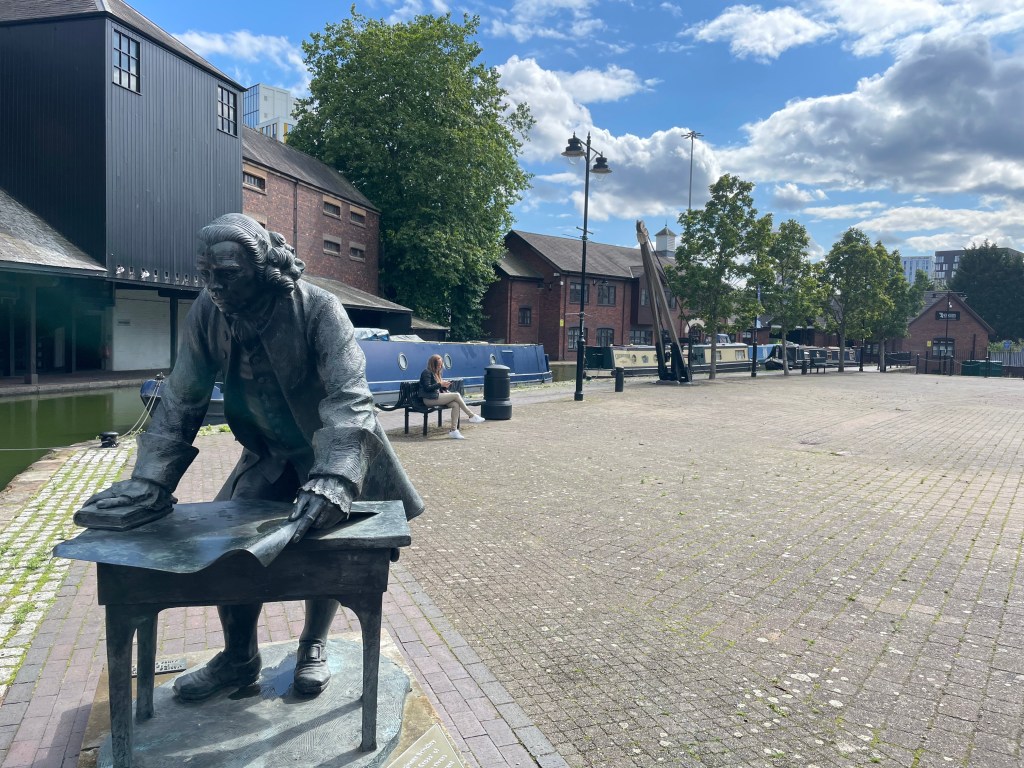
1. Stratford is beautiful. The river and canal basin are the centre of the town, overlooked by the Royal Shakespeare Company theatre. There is a large green park and lots of statues.

2. Everything is Shakespeare themed. Shakee’s icecream barge, Thespians Indian Restaurant, Shakespeare in Love Wedding Boutique, and even the Shakespaw Cat Café.

3. It has real history. You can visit the houses of Shakespeare, his wife Anne Hathaway and his mother Mary Arden. And for boating geeks like me you can find out about Stratford as a port, when boats from Bristol came up the Severn and the Avon before transshipping their goods onto narrowboats for the midlands and the north.

4. Anyone can get on a boat. Lucky narrowboat owners like me are joined by large and small tourist boats blaring their commentary to all and sundry, and land lubbers trying a tiny rowing boat or a paddle board on a pretty wide river.

5. It is full of tourists. People from all over the world come to Stratford, either individually or in organised groups. Hordes of school children swarm the streets, clutching their quiz sheets. All life is here.

But not everything is perfect. Here are just two things I liked rather less:

1. Stratford is noisy. After enjoying the peace of mooring along the river it was quite a shock to be based in a city centre, especially the revellers at midnight, singing and banging a drum.

2. It is full of tourists. We are always happy to answer questions about living on a boat from inquisitive onlookers. But when they climb onto the boat to have a look, or in one case, just to wash their hands in the canal, that is going too far.

So we enjoyed our time in Stratford but were also happy to leave it, and I am writing this moored up in the countryside, with nothing around us. No tourists, no locals, not even another boat. It is lovely.

Is every day the same on a narrowboat?

One question we often get asked by non-boaters is whether we get bored because every day is just the same. The answer is that we never get bored because every day is different. We learn something new each day. We see something new each day. Let’s look at this week as an example.

Last Friday, we travelled from Penkridge to Compton, an unusually long day for us – about seven hours cruising. Despite going through the middle of Wolverhampton in the West Midlands, this is a pretty canal. It is one of the earliest, built by a chap named James Brindley and opened in 1772, and uses the contours of the land rather than cutting through hills and using locks to go up and down. Near Compton I found this pretty Victorian arts and crafts house to visit.

On Saturday, we stayed in Compton for a lazy day. I found a nice long walk for the dogs – along the canal, across countryside and back again along this disused railway line. Fascinating to imagine the heavy steam trains, the grime and dirt. It was a hot day and in the afternoon we found a country park where the dogs could swim. Pizza for team and a film.

On Sunday, it was back on our journey south. A boat coming the other way warned us that a boat club was ahead of us. Fifteen boats were waiting to go down Bratch Locks. This is a bit of a bottleneck on the canal, because three locks are next to each other, so they allow three boats to go down and then three come up. This means if you are boat four, you will wait around an hour before you can go. If you are boat fifteen, you could be waiting several hours. Fortunately by the time we got there the queue had reduced and we were only held up for around forty minutes. Bratch Locks are fascinating. They were built by Brindley as a staircase, where the top gates of one lock form the bottom gates of the next one. But this used too much water, so around 1820 they were converted to individual locks with about a meter of canal between each lock, and side ponds to hold the water. I have never seen anything like them, and as you can see in the photo, the rules are somewhat complex. Fortunately there were volunteers to help us and all was well.

On Monday, we passed through a number of small villages with great names such as Boterham, Giggerty and Bumblehole. We even went through Swindon – not the massive 1960s sprawling town in Wiltshire, but a hamlet of a few houses and a pub in the West Midlands.

Tuesday was a short day. Just a couple of hours from Stewponey to Wolverley. We moored in a beautiful tree lined stretch, next to a brilliant pub called the Lock Inn. It cooked traditional Black Country food. I had a couple of pints of the local ale, and an enormous plate of Faggots and Mash. We considered staying another day, so we could see the Morris dancers, but in the end decided to carry on.

On Wednesday, we continued to the end of the Staffordshire and Worcestershire canal at Stourport. Stourport was once a very small village called Mitton, but after the canal was built became one of the busiest inland ports in Britain, as the canal joins the river Severn and from there large boats sailed down to the sea at Bristol. Nowadays it is a sleepy pretty town, with much history to see. It also has a permanent funfair, where we found this rather sad Winnie the Pooh.

Thursday was another day off and we stayed in Stourport. We took the opportunity to enjoy this small breakfast. Yum! We also went on a trip to see Dudmaston, a huge stately home that is still lived in by a (rather wealthy) family.

So no. Every day is not the same on a narrowboat. Every day brings something new and we are very lucky to enjoy it.

Everyone is unique on the cut

We meet so many different people when we are out in our narrowboat on the canals – “on the cut”. There are the first time boaters on a day boat or a one week hire. There are live-aboard boaters who move up and down a canal but broadly stay in the same place. And the liveaboards who moor in a marina. Then there are the continuous cruisers like us that travel around the UK throughout the year, and the cruisers that travel just every few weeks. We meet hippies and families, engineers and accountants, solo boaters and people squeezing ten onto a boat. I love them all.

I think one of the things I love best is that I meet all of these boaters every day, in a lock , on a mooring, as we pass. And the mutual respect is palpable. We may bitch about the Canal and River Trust, who regulate what we do. We may bitch about hire boaters if we are live-aboard, or about the “owners” if we are hiring. But day to day we rub along just fine. I have never met such a diverse group of people who get along as on the cut.

Good luck to Mark. It is a special kind of person who can live with a narrow-boater. I hope you find someone special.

It’s my birthday and the engine bay is full of smoke

It was my birthday on Wednesday and it was planned to be a very special day. My younger son Martin had joined us on the narrowboat, we had a lovely cruise expected through Stoke on Trent from the lake at Westport down to the village of Barlaston, where we would have dinner in the pub owned by actor Neil Morrisey. It should have been perfect.

But…

About an hour after we set off, the engine suddenly cut out and smoke started to appear around the boards above the engine bay. The picture does not really show how bad it was – when I took the boards up I could not even see the engine for smoke. Taking photographs was the last thing on my mind.

Fortunately there were no flames and nothing was alight but the oil cap had blown off, everything was massively hot, and we were stuck, next to a recycling centre in not the best part of Stoke. And of course, a three hour thunderstorm had just begun.

Even more fortunately we recently renewed our membership of River Canal Rescue (RCR), which is like a car recovery service for boats. I called them and told them my engine had blown up. They calmed me down and convinced me that was not the case, and within 30 minutes they had an engineer with me at the boat.

It took some diagnosis but we eventually realised what had happened. Through simple wear and tear, the bearings in the engine water pump had begun to fail, and caused a vibration. That had “thrown” the drive belt off, which meant that the engine was no longer operating the water pump, and so the engine was no longer being cooled, and simply got hotter and hotter till eventually it boiled off the coolant and everything gave up.

This could have been a massive issue, The cylinder head might have seized, or a major gasket blown. But when it all cooled down and we turned the engine on, everything still worked.

So we moored up properly, RCR ordered a new water pump, and found a local engineer who could fit it the following morning. It did take a lot of work with a mallet and a crowbar to get the old pump off, but by 1130 the following morning we were all fixed and on our way.

So what have I learnt? Nothing new but some lessons reinforced.

  • Living on a narrowboat s**t happens. It will be OK. Get over it.
  • Expert help is invaluable, even just to reassure. Well worth paying for,
  • Planning is great, but the unexpected is always just around the corner.

So what about my birthday? Well using taxis we still had that delicious meal. And we have planned an alternative birthday on Sunday, when we should be moored in a marina, with access to a car. That should be a very special day. And I do not regret my birthday. It was an adventure. Retirement is all about adventures,.

Hatching week

We have been travelling the Peak Forest Canal this week, a sidearm off the Macclesfield, that was used originally for transporting limestone from the Peak District quarries. These days the industry has gone and it is very beautiful as it clings to the sides of steep hills, with far views across the national park. As we travelled towards the end at Bugsworth Basin, we noticed a number of ducks and geese sitting on their nests. We also saw one goose with four new baby goslings, which were cute.

Just a few days later we returned along the canal and were astonished to find maybe fifty families of geese and ducks with goslings and ducklings. It made me wonder how they all hatch at once. I understand the principle that hatching in late spring gives the best chance of survival, but for so many to arrive within a few days is pretty incredible.

It reminds me of a holiday we once had at a house in Islay, an island off the West Coast of Scotland. When we arrived we asked if there would be many midges, the infamous biting insects of that part of the world. The property owner said that they would come the following Thursday, which we guessed was a random date, plucked from the air. But no, we had no insects till the Thursday, when clouds of them suddenly arrived.

Nature is a wonderful thing.

Not a bad way to spend our retirement.

Back in Scotland. Wishing we were on the boat.

We have had to return to Scotland for a couple of weeks. A few minutes after we crossed the border we saw this sky, welcoming us home with the flag. But in truth Mandy and I are already missing the boat.

Our niece Lucy is getting married so we need someone to look after the dogs while we go to the wedding. We are very excited about their big day and to see all the families but we still want to get back to the boat.

We are also going up to the farm in St Andrews where another niece, Rachael, and her family live. We have not seen two year old Fred for a while, and it is lambing time, and Mandy’s brother and sister in law are there, so we are very much looking forward to that. But we still want to get back to the boat.

While we are in Scotland we have arranged to see the doctor, dentist, get the smart meters fixed, get the dogs hair cut for the summer, get our own hair cut. Some of these are really tricky to do when we are travelling. For instance, a doctor visit is difficult because the Scottish and English National Health Services do not talk to each other. So all important things to do, but we still want to get back to the boat.

I know. We are very privileged and so lucky to have these opportunities. It is important to love every day and not just wish for the future. And I do. It will be a wonderful wedding, excellent to see Fred and all. I am even excited about the smart meters!

But I still want to get back to the boat.

When can I go back to the narrowboat?

I was hoping that this week’s blog would be about my return to the narrowboat, after having a new kitchen fitted over winter. I know the washing machine has not yet arrived but that is not urgent, and I really want to get the boat set up for the summer season. Unfortunately I found out on Wednesday that the new cooker is installed but is not yet converted to bottled gas, so I would have no way of making food or boiling a kettle. The limited electricity on a boat means that things like electric kettles and microwaves are rarely used.

The new kitchen – work in progress

I am hoping that on Monday the new “jets” will be installed and I can travel down to the boat on Tuesday. I am bracing myself because I have not been on the boat since November, so something is sure to be broken. But we have plans for travelling the west of England this year, so the sooner I get back, the sooner we can resolve any issues and get going.

Last year we travelled for seven months, all around the South of England. This year we plan a more mixed summer, where we travel for 5-6 weeks and then return to the house for 1-2 weeks before repeating. That way we can keep the house in good order, and still make the most of the boat. It will also help us work around some events this year, such as my niece’s wedding and a weekend at the London E-Prix (Formula 1 for electric cars).

On the boat we also have targets – to spend time around Gloucester docks, to see our younger son in Tewkesbury, to cross the Pontcysyllt Aqueduct and navigate the recently reopened stretch of the Montgomery canal. I also want to return to the boat museum in Ellesmere Port, and possibly to explore the many canals of Birmingham.

So hopefully by next week’s blog I will be back… We will see.

How to find your way around the British Canals

I am getting excited now as we get nearer to returning to our narrowboat and travelling around the British canals this summer. We have been having work done on the boat including a new kitchen, but that should be ready soon, so hopefully by the end of the month we will be back.

The UK canal and river network is extensive – some 2000 miles – travelling through vast tracts of countryside, and connecting most towns & cities. Before the railways it was the best and fastest way of carrying goods from place to place, and despite falling into disrepair in the first half of the twentieth century, most of the navigations (the official name) are now open to traffic again. Volunteers and the Canal & River Trust keep the waters clear and the locks operating. It is somewhat easier than other countries because most of the equipment is self service and we can take our narrowboat anywhere we like, whenever we like.

Just a few of my guides

So of course that begs the question of how we know where to go. The answer is a mixture between 21st and 19th century technologies. There are some great apps and websites. One of our favourites is “Canal Plan AC” website, which is brilliant at working out how long it will take us to make a journey, and where likely stops are along the way. It takes account of fast and slow navigations, and time to get through locks, as well as how many hours a day we want to travel, and where are good places to moor. The other app on my phone is “Open Canal Map” which allows me to track our journey live and zoom in and out of the canal maps, for instance to see where a water point is, or a recent stoppage.

But I have to admit, despite the advantages of technology, I prefer to use proper paper books. There are two sets of canal books in common use in the UK – the Nicholson Guides and the Pearson Guides. Pearsons are more chatty and have simplified maps. Nicholsons are more comprehensive and have the detailed Ordnance Survey maps. Both guides have been around for over 50 years and are updated every few years. I had always thought that was done by hundreds of editors but by coincidence we have become friends with Jonathan Mosse, who lives on a boat near us in Scotland, and does most of the work to keep Nicholson guides up to date. When he started in the 1970s, he would spend his days boating and cycling along canals. These days he can do a lot of the research online, but he is still always grateful for updates from boaters like ourselves, who travel the canals every day, and can let him know when a bridge number has changed or a pub has closed.

This week, he kindly sent me the guides that have been updated for 2023 – covering the North West of England. They are shiny and new but it will not take long till they are covered in muddy thumb prints and hand marked updates. I feel privileged to play a small part in keeping everyone informed as we share the navigations.

If you have never had a narrowboat holiday in the UK, I recommend it. The slow pace of life will bring mindfulness and calm, even if just for a week. And don’t forget to get a copy of your local guides.

Blog at WordPress.com.

Up ↑