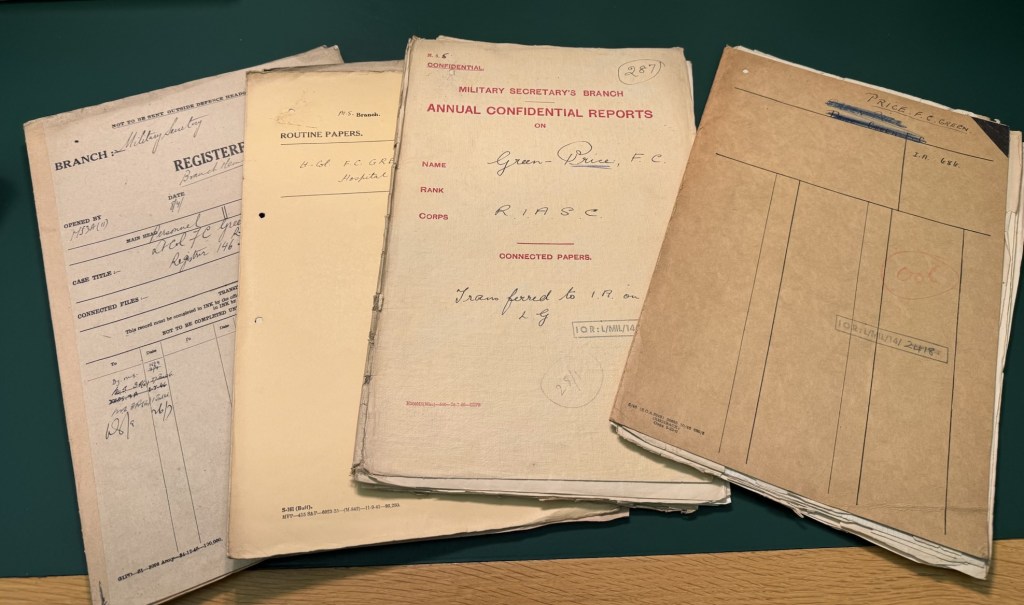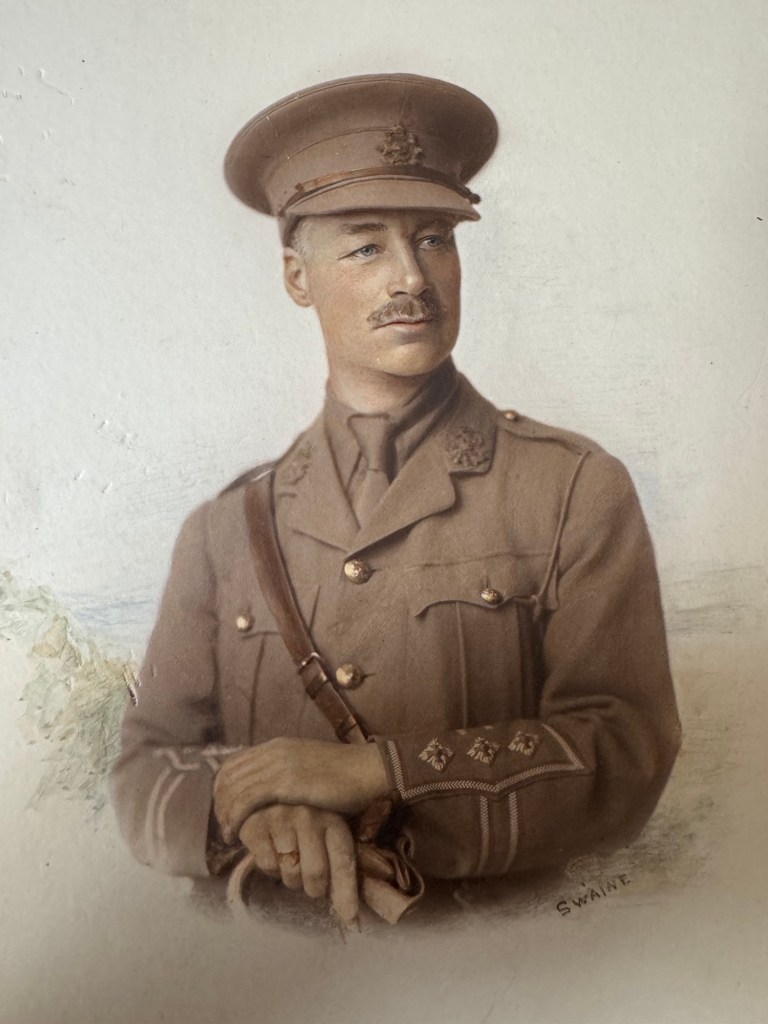
I have written before that one of my hobbies is researching my family tree. This week I received a pack of old photographs from one of my Mum’s cousins. He has been tidying his house and knew that I am interested in the family, so sent them to me. He kindly annotated the backs of the pictures when he knew who they were, but this photograph was blank.
Most of the pictures are from the family of a man called John Davies, a distant cousin who was a chaplain serving in the Royal Navy, I knew the navy had chaplains but did not realise that they sailed on the ships for many months, just like ordinary sailors. John also served on submarines where he said that the confined space led to depression and need of a chaplain.
There were also photographs and newspaper articles about John’s relations. His father and grandfather were also priests, working in a small area of Wales. His grandmother was a very posh looking woman called Dorothy Jebb. She is my great great aunt and came from a very wealthy family.
But I am still stuck on this photograph. He looks a very smart soldier, I am guessing from the First World War. With three crosses on his wrist, perhaps he was a captain? John and his father both had low eyebrows, so it is not them.
In future times perhaps AI will allow me to search this photograph and find who it was, but for now I think it is sad that such a photograph, maybe made for a mother or sweetheart, cannot be identified. I will raise a glass to him.
My Dad died with Alzheimer’s in February 2022. I miss him but I do not miss his last few years, when he was a shell, who knew nothing and nobody. It is a horrible disease. Understandably I worry about getting older myself and look for signs of memory loss. I forget the names of people I know well, and sometimes I mix up words. For instance I might look for a “mooring space” for my car.
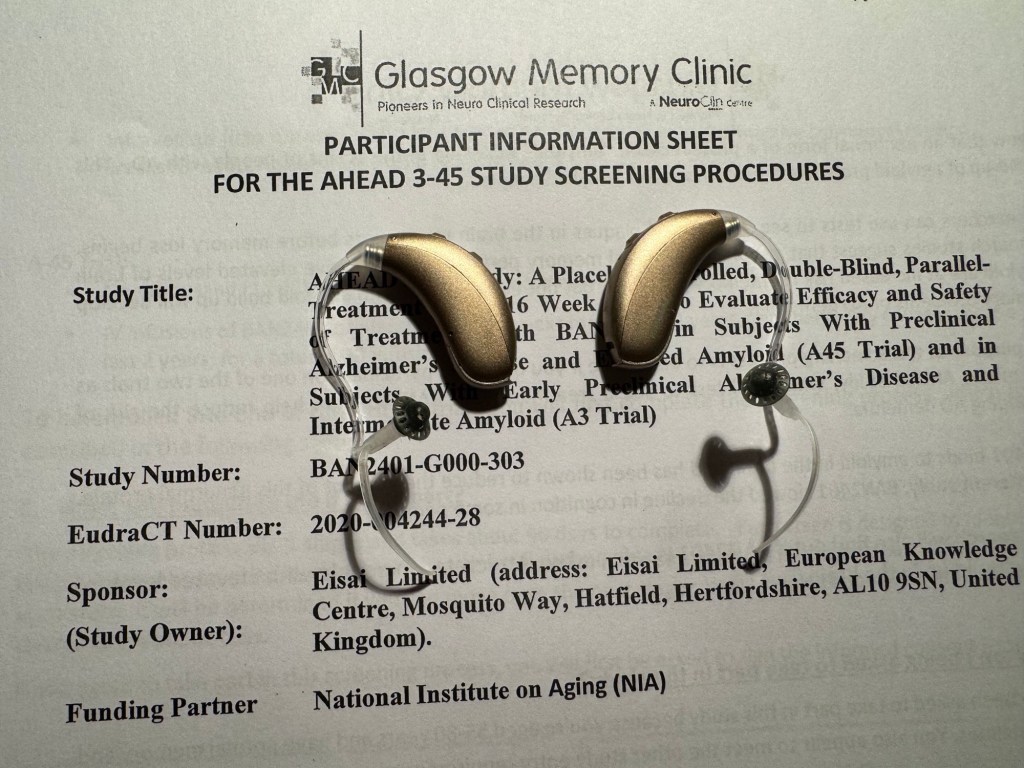
This week I was given the opportunity to join a research study about healthy people who might get Alzheimer’s in the future. They took my blood and have sent it to California to get the latest testing for signs of p-tau217, a protein which indicates the formation of amyloids in the brain, believed to be the cause of Alzheimer’s. If the test is positive, I will then go on to get MRI scans of my brain and then either an experimental drug or a placebo to see the results. They will also check my blood DNA to look for a particular gene which increases the chance of the disease.
Whatever the results, I will learn something and will help the research which is likely to help many others in the future.
Attending the clinic also reminded me about hearing aids. I have quite bad hearing at high frequencies but normal hearing at middle and low frequencies. Two years ago I tried out private hearing aids to see if they would help. They were expensive and I did not get much benefit so I gave up on them. But my hearing has deteriorated so I went this week to pick up some NHS aids. The doctor told me that many people give up far too soon, and that I should wear them every day for at least eight weeks before coming to any conclusions. She also said that latest research shows that wearing hearing aids can reduce the risk of dementia.
So that is what i am doing. Three days in to wearing them and so far so good. The world does sound a little hissy and scratchy because I am not used to the high pitched sounds yet, but I will persevere. And if it helps with my brain, so much for the better.
What do you think about what I am doing? Does it make sense, or after my father, am I just understandably paranoid?
I have been reading a fascinating book this week by Ben Goldacre called “I Think You’ll Find It’s a Bit More Complicated Than That”. It is a collection of his articles written in the early 2010s, arguing why we need more factual and evidence based decision making and media. One of these articles was a 2011 paper for the UK government about how education could and should be more evidence based. It really gave me pause for thought and made me consider the problem I have with teachers.
When you meet someone at a party and they tell you what they do, there are often stereotypical reactions. When I used to tell people I was a banker, I would gird my loins for being told that all the ills of the economy were due to my greed. When I told then I worked in IT, I would often see their eyes glaze over. Now, when I tell them I am retired, they look at me as if I am mad, and try to find the reason I “can’t” get a job. In return, when someone tells me they are a teacher, I can almost feel the atmosphere chill, as they prepare to defend themselves against jibes about their lengthy holidays or inability to do a real job. Personally I have huge admiration for teachers. Indeed, for many years I wanted to be one myself. Helping children grow to well rounded, well educated adults must be one of the best things a person can do. But…
The defensiveness I mentioned goes a lot further than responding to dinner party comments. I am not sure why, but I find teachers, possibly more than any other profession, are unwilling to accept criticism, or suggestion of how things could be done better. I am even nervous to write about it because I know teacher friends will already have their hackles rising. Ben Goldacre is a doctor and draws analogies from his own profession, where up to the 1970s, consultants would reject evidence as attacking their professionalism, judgement and brilliance.
Surely teachers, as with any other profession, should not choose teaching methods because “that is the way it has always worked”, or “that is how I like to do it and I am the expert” or “that is the latest fad I have heard about”. There should be proper systematic randomised controlled research which would tell us factually what works and what does not. I have spoken to teachers who reject this idea as something being done to them. But there is no reason for that. In medicine the research is owned by the profession, supported by statisticians. It could be the same for education.
The good news is that in the US, and more recently the UK, education policy does seem to be going in the right direction here. A 2017 £75m investment in the Teaching and Innovation Fund to support evidence based education may help. But teacher defensiveness along the lines of “But every child is different, every class is different” is common. As an example read the article “Education research is great but never forget teaching is a complex art form” by Thomas Rogers. These are just the kinds of arguments that used to be heard in medicine, or indeed in my old profession of IT, and have largely been debunked.
I admire teachers. I admire their professionalism, their work ethic, their talent. I sympathise with the way they are lectured by politicians, journalists and me. Now is the time for them to take ownership for evidence based education, even if it means slaying a few sacred cows.