We have sold our house, visited our sons, sorted the packing. And now we are back at the boat. The plan was to be back on the move by now. So why are we still moored in Lyme View Marina?
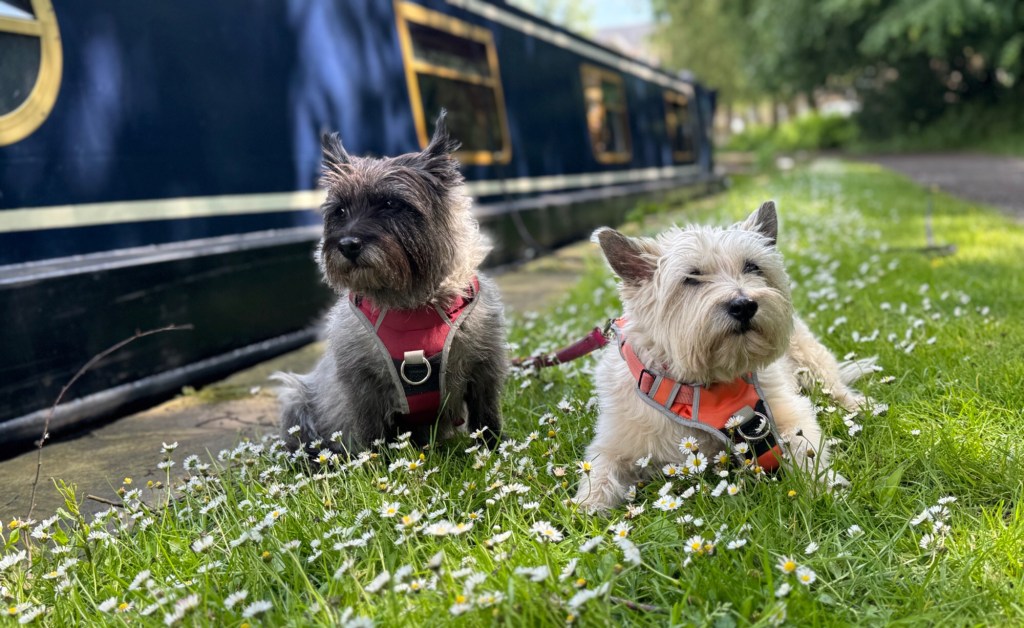
It is all about Ziggy. We have two dogs – Lulu and Ziggy. Last week we took them to the vets to get their teeth cleaned. Lulu was fine but when the vets checked Ziggy’s blood, she was found to have really low sugar levels. Since then she has undergone a number of tests and the vets have ruled out the most common diseases. We have left Scotland because we no longer have a house, but the vet there has called us to say the most likely problem is an insulinoma, a growth on the pancreas.
So rather than setting off on our journeys we have registered with a local vet near Manchester and are waiting for a an ultrasound scan to see what is going on. Ziggy seems fine in herself so hopefully it is not too serious, although the prognosis for insulinoma is not great.
In all honesty I am finding it a little frustrating. I want to be back on “the cut”, cruising the canals. But Ziggy is family and family comes first.
At least this gives us time to do some house hunting and have some adventures. It was not my plan, but sometimes plans have to change. Apparently.
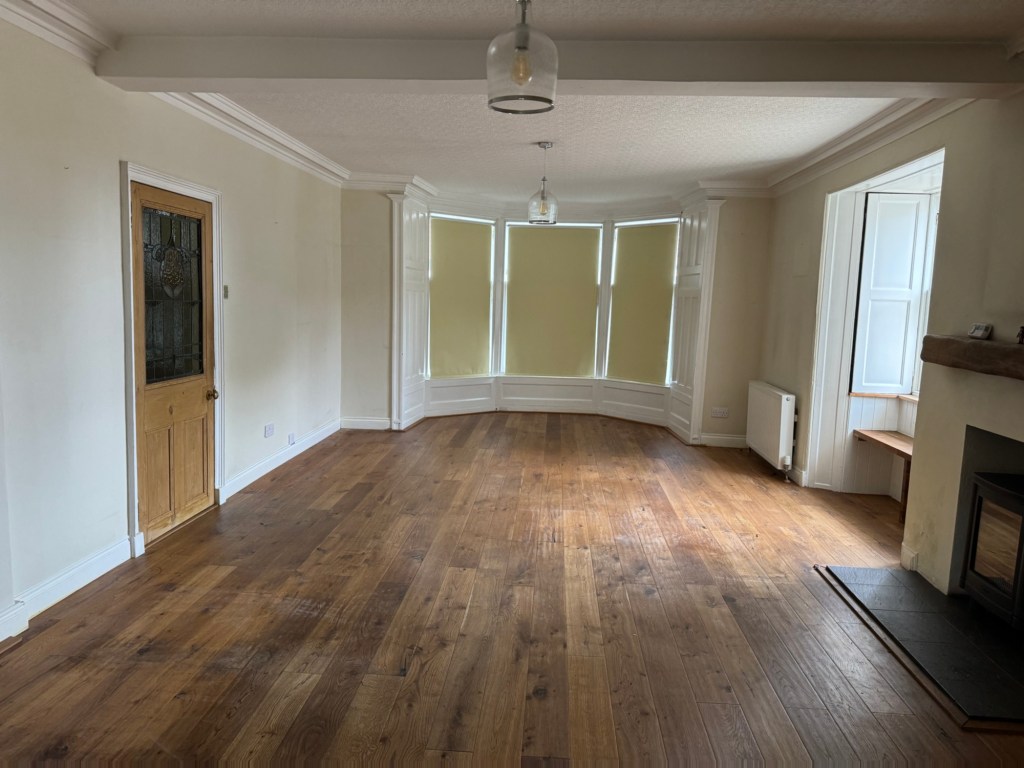
By the time this blog is published, we will be houseless. After nearly two years on the market our house in Scotland should complete its sale today and will have new owners – a lovely family who will get to enjoy the history of this nineteenth century farmhouse which became swallowed by a new town in the shale oil revolution around 1900.
I deliberately use the word “houseless” not “homeless” because we still have a home on our narrowboat. Dictionaries define “home” as simply the house where you live, but I think it means more. You know you are home when you sit down with a happy sigh. It is the place where you feel most comfortable and most safe. So much more than a house.
And when we arrived back at the boat last night we immediately felt at home. It just feels so right to be here. Putting all our stuff into storage this week has been pretty stressful. It has also reminded me how over the years we have collected things that we really don’t need. We are no happier in a house surrounded by chattels than we are in the boat where we have very little.
We do still want a house as a base for winters, and for the future when we can no longer operate locks or moveable bridges. Next week we will be staying with our eldest son and his fiancée near Brighton. We are looking forward to seeing them and their new home. And when we then return to the boat, we will properly start our house hunt.
But for now it is great to be home on Narrowboat Thuis. Entirely appropriately “Thuis” is Dutch for “home”.
Mandy and I have moved house twelve times since we have been together. It has become a joke amongst some of our friends who say they never know where to send the Christmas card. I often claimed that it had just become normal for us. People would ask me why I never wanted to put down roots. I would say that we are just good at setting up a new home anywhere we go.
But this time feels more stressful.
As you know we are retired and spend more than half the year on our narrowboat. That certainly feels like home when we are there. But we want to keep a house for the winter, when it is muddy. We want to keep a house for when we get bored of the boat or are too infirm to open locks. We want to keep a house so we have somewhere with a little more space for our stuff.
And this time, instead of moving for my work, we are moving closer to Mandy’s family and friends, from Scotland to Lancashire. This week we have been spending time in both as we look to sell and buy.
The sale process has been fraught. We have been “on the market” for two years and twice we have thought the sale was happening. The first time the buyer turned out not to have the money after several months. The second time, the chain of buyers fell apart at the last moment. We have waited and we hope that in two weeks we will be moved out. It has been stressful, and the solicitors are still throwing out last minute complications such as whether we can find some paperwork the council signed off when we did work on the house seven years ago. But the removal company is booked and we have begun things like cancelling utilities. We have not enjoyed selling the house at all.
We have tried to keep buying a house less stressful but we have failed. The idea was not to look at houses until we were sure the sale was happening. Our plan instead is to live on the boat while we look. But last time we were confident and found a lovely house. Of course that has gone after the failed sale, so this week we have been looking again, with our fingers crossed on the sale. This weekend we are driving round Lancashire viewing our shortlist of houses. This should be an enjoyable time. It should be exciting to find our new home. But for some reason we are not feeling excited. Perhaps it is the worry that the sale could still fail. Perhaps it is the worry that we will make a bad choice. We are not enjoying buying the house at all.
I am naturally a very positive person. I am confident it will all work out for the best. But I don’t this stress. Maybe it is because I no longer have the stress of work, so this seems like a bigger deal. Maybes it is because it is summer, and we would rather be back on the canals. But we just want to hide in our narrowboat.
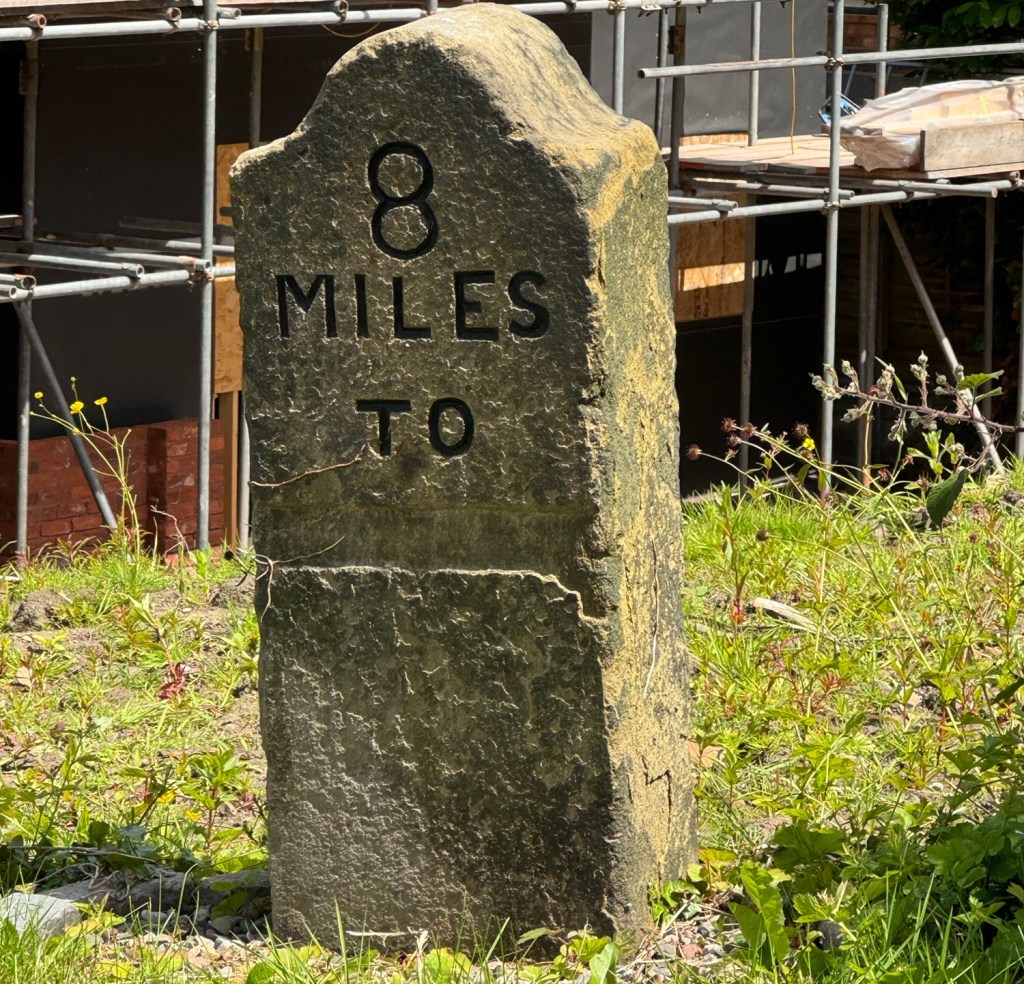
This milestone is next to Marple locks on the Peak Forest Canal. I like it because it represents much of our life on a narrowboat. We travel. We see places. We plan our routes. But ultimately we have no destination. It is the journey we enjoy. That is so different to travelling in a car, where the destination is everything, and the journey is just about getting there.
And by enjoying the journey, we discover more. This week we have found wonderful moorings, just avoided big delays from closures, and been on adventures.
Starting with the adventures, I walked along a long old tramway that used to carry limestone from the Peak District down to the canal. I had a day out in Buxton, the highest town in England with history back to the Romans. And I walked to the foot of the Marple Aqueduct, the highest stone aqueduct in the UK.
The canal stoppages included a whole stretch of the Macclesfield canal which is currently closed due to the canal leaking. This is extremely serious because not only could it cause flooding of nearby land, but it could also lead to the whole of the canal draining and leaving us boaters marooned. We also found ourselves stopped halfway up the Marple lock flight, when a “pound” between two locks had drained due to a paddle being left up. And when the lock keepers let more water down to help us, the water flooded a brand new house that has been built next to the flight while it has been closed for the past ten months. Someone will need a word with that surveyor!
And we stayed at two of my most favourite moorings on the whole canal network. Bugsworth basin is like a dock at the end of the Peak Forest Canal, near Whaley Bridge, with space for up to forty narrowboats. Originally it would have been used to transship the limestone from the tramway onto boats to carry around the country. These days it is full of wild flowers and geese. So it has a dramatic mixture of old ruins and nature. Also a very good pub.
My other favourite mooring is further up that canal on an isolated stretch, with an incredible view down into the valley at a village called Strines. Apart from the occasional hiker or cyclist we have the place to ourselves, and it is just so very chilled. A beautiful midpoint on our journey to nowhere.
We completed the Rochdale and Ashton canals this week. Both have pretty terrible reputations as they go through some of the most deprived areas of Manchester. But what is the truth? Let’s consider some of the stories you hear.
1. They are really hard work. True. The Ashton out of Manchester is just lock after lock. The Rochdale has very heavy lock gates and some of the paddles require super human strength. Some of the pounds between the locks drain all too easily, leaving the boat grounded. Everything is doable but it is hard work.
2. They are very beautiful. True. I was not expecting quite how beautiful considering the canals travel through areas that once were heavy industry. Calderdale between Sowerby Bridge and the summit is particularly lovely, as is the top end of the Ashton as it joins the Peak Forest.
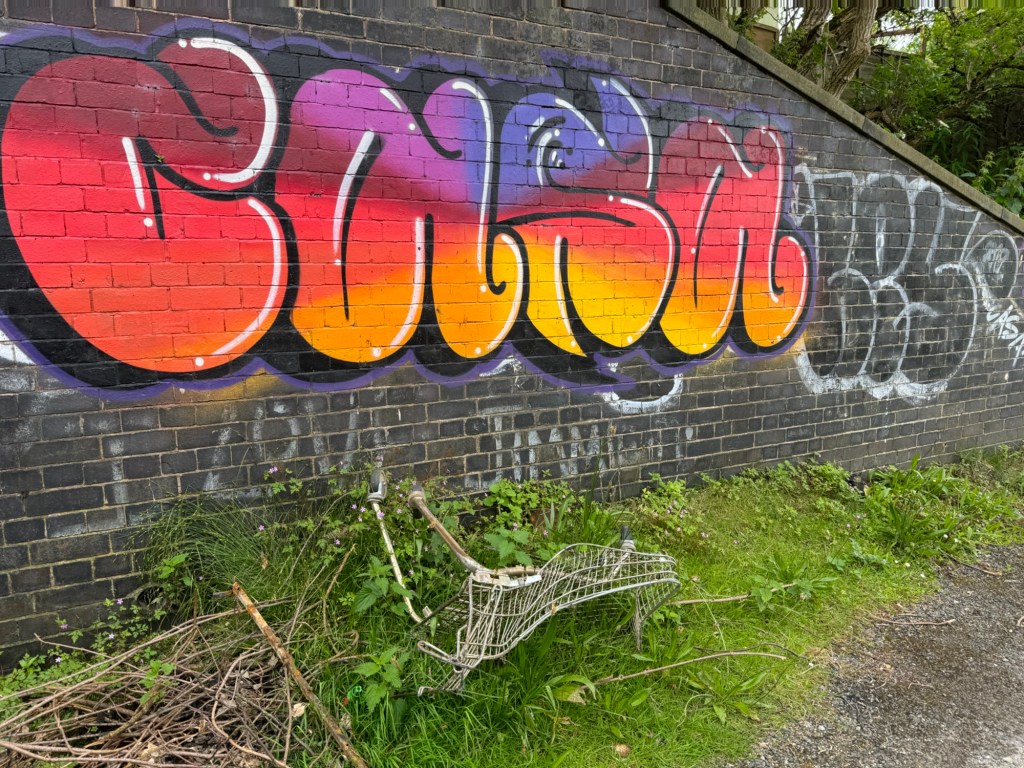
3. They are full of junk. Sadly true. We lots count of shopping trolleys, items of clothing, plastic bottles in the canals. The trick is to keep the boat in the middle of the canal, but even then we found ourselves stuck on silt banks and with a coat wrapped around our propellor.
4. There are lots of dodgy characters. Partly true. As with all city centre canals there are occasional drug users and inquisitive kids, but we found that if we engaged with them as human beings there was no trouble,
5. The canals are hard to navigate. Mostly false. So long as you don’t try to go too fast, stay away from the junk, and fill up empty pounds, it is not so difficult.
6. They keep getting blocked. True. Failing locks and falling trees caused five or six blockages while we were on these canals. One or two of them looked as if they might delay us for weeks. The fact is that the Canal and River Trust no longer do preventative maintenance. They just fix things when they break. I understand they have no money but I think that is a mistake.
7. You can’t find somewhere to moor. True. The canals are very silted so it is not possible to moor by most towpaths. There are numerous locks with no mooring between them. The good news however is that we found some fantastic moorings. Hats off to the Hopwood Arms for fantastic fresh pizza and allowing me to use their water tap to fill my boat.
8. They are low on water. False right now. By reputation these canals can run out of water because the locks leak so badly, and we did experience this a little but in general it has been a very wet year. Bad for our moods but good for keeping the canals filled.
9. No one uses these canals. True for the Rochdale. The Ashton Canal forms part of the “Cheshire Ring” and so gets a fair few boats, but the Rochdale was very very quiet. We saw a few hire boats between Sowerby Bridge and Hebden Bridge, but between Todmorden and Central Manchester no more than six or seven boats travelling like us.
10. They are good to do once but that’s all. False. I must admit when we had finished the long final day into Manchester on the Rochdale I did say “never again”. But I think the pluses make it worth it. Lovely dramatic canals with a great mix of countryside and old industry. We will be back…. one day.
This week we have been travelling on the Rochdale Canal, from Sowerby Bridge over the Pennines to Littleborough and then next week to Manchester. I have avoided doing “the Rochdale” on our travels because it has a negative reputation of being very very hard work. But the plus side is the very dramatic countryside, especially when you go over the top to an aptly named village called “Summit”.
The reputation for being hard work has been borne out, with low water levels, heavy lock gates and sticky paddles, as well as a tree across the canal. And we have not done the hardest bit yet, the run down to Manchester Piccadilly. But we have had a good week, visiting an area where we used to live – Calderdale, home to the “Happy Valley” TV series – in real life with fewer murders.
We have had an evening and a day with Mandy’s brother Stephen, helping manage the locks, and our son Tin has popped by to bring us various post from home. So it has been a week of scenery, family and aching muscles. A good week.
We have cruised most of the canals and rivers in the UK in recent years. There are over 2000 miles of navigation and every one is different. But this week we have been along the Calder and Hebble and that really is unique.
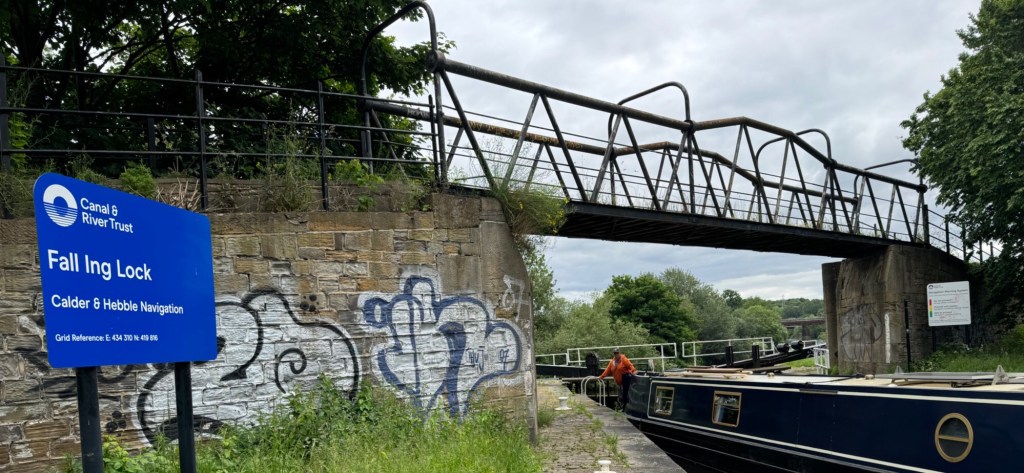
From Fall Ing lock near Wakefield, to Sowerby Bridge, the canal and river navigation is just 23 miles long, built in around 1770 to connect the mill towns of Yorkshire to the rest of the country.
Let me tell you about three things you will not find anywhere else. The first is the short length of the locks. They can just about fit our narrowboat at 57.5 ft, but any longer and you really are in danger of getting stuck or flooded. There are other canals known for short locks, including the Leeds and Liverpool that we have recently left, but none as consistently short as the Calder and Hebble.
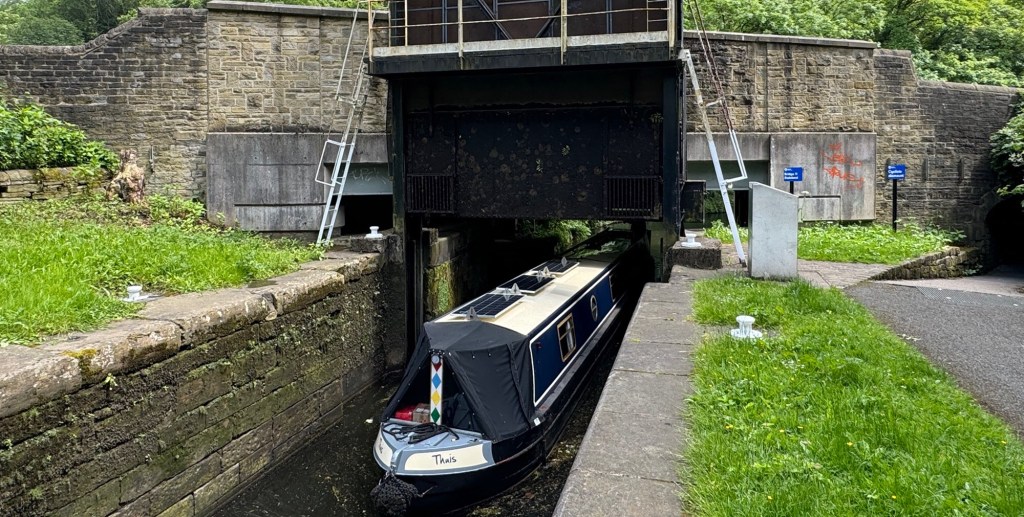
The second uniqueness is the Guillotine lock at Salterhebble. Most locks have pairs of wooden or steel gates that close together to hold the water back. Sometimes these are electrically operated but this one also operates as a guillotine, a single metal gate that goes up and down. It was installed after a road widening meant there was no room to keep normal gates. I have read that there are a few other guillotines around the country but as far as I am concerned this is unique.
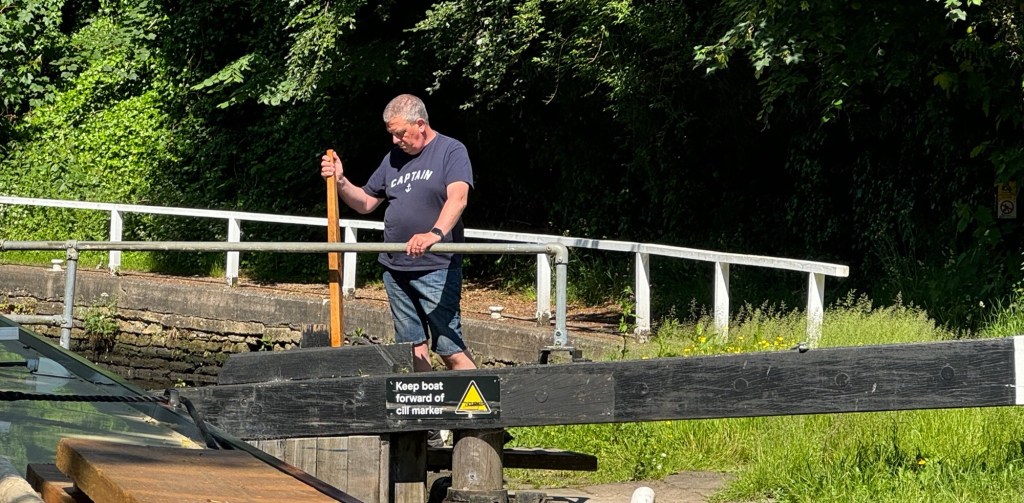
The third unique thing is the “Hebble spike”, a piece of 3” x 2” shaped hardwood that is used to open and close lock sluices. I have no idea why these were used when this canal was built, rather than the windlasses we use on almost every other canal, but it has certainly been a unique experience to use this week. It is hard work!
I have enjoyed the week of uniqueness. Next week we travel the Rochdale canal. Maybe not so unique but even more of a challenge. I’ll let you know how we get on.
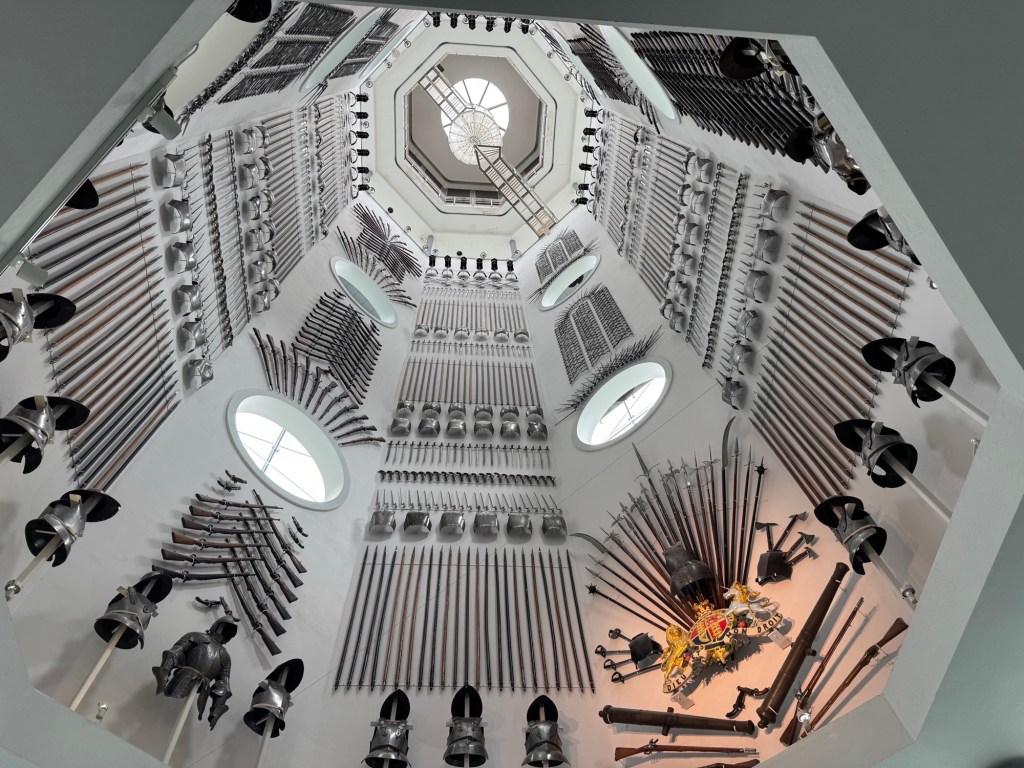
One of the best things about cruising the canals is mooring somewhere new and exploring the area. Perhaps there is a lovely country park. Perhaps there is a stately home. One of our moorings this week was right outside the Royal Armouries Museum in Leeds.
I have been here before many years ago and I remember being excited to see the thousands of weapons held by the museum. It is a truly remarkable collection. And this week when I visited I felt some of the same excitement. I saw a presentation about the ancient Greeks and how they fought. I saw a special exhibition about decorated weapons, including a gold Kalashnikov produced by the Saudis. I tried on a helmet from a suit or armour with just a small slit for the eyes. It felt very claustrophobic.
I did enjoy my visit but this time I also felt a sense of unease. Maybe it is just because I am getting old, but I was very aware that all these weapons had been produced not for exhibit but to kill and maim human beings. The museum is aware of this and even provides a quiet room you can go to if you get upset. I was certainly surprised at my own reaction. It reminded me of what is happening in Ukraine and Gaza right now.
I think as you get older, your sense of the value of life increases. And this has made me sad. Is that stupid?
Most of the time as narrowboaters we are “ditch dwellers”. The canals we navigate are surprisingly shallow – say three to four feet deep . So if you fall in you can just stand up and you will normally be fine. For this reason we do not wear life jackets on the canals. But rivers are something more challenging.
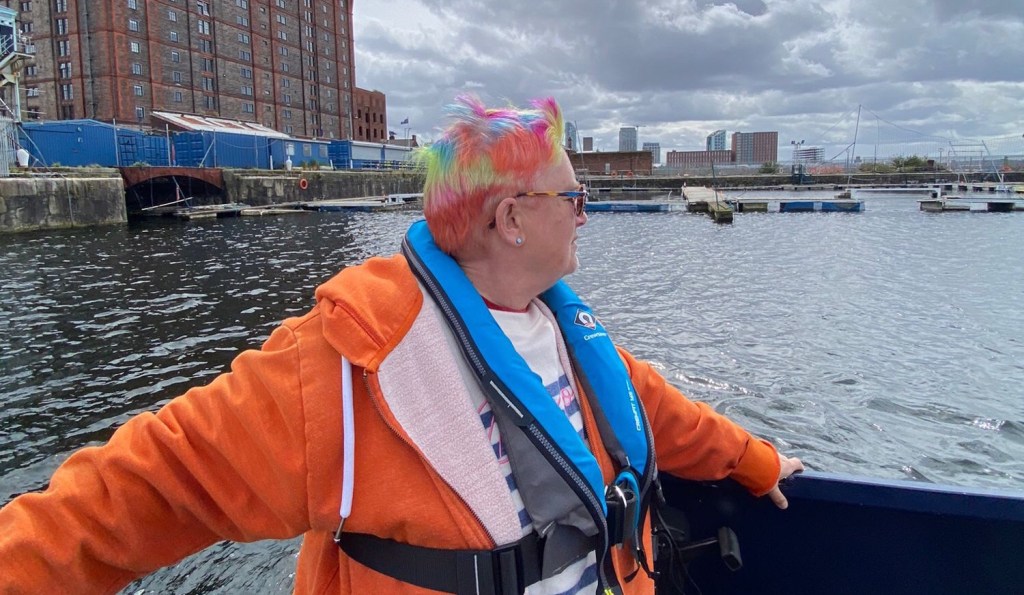
Liverpool docks this year
Rivers are more dangerous because they have a current, may have a tide, and can be much deeper. They are also unpredictable. For instance flat bottomed narrowboats do not have much protection against strong lateral gusts of wind.
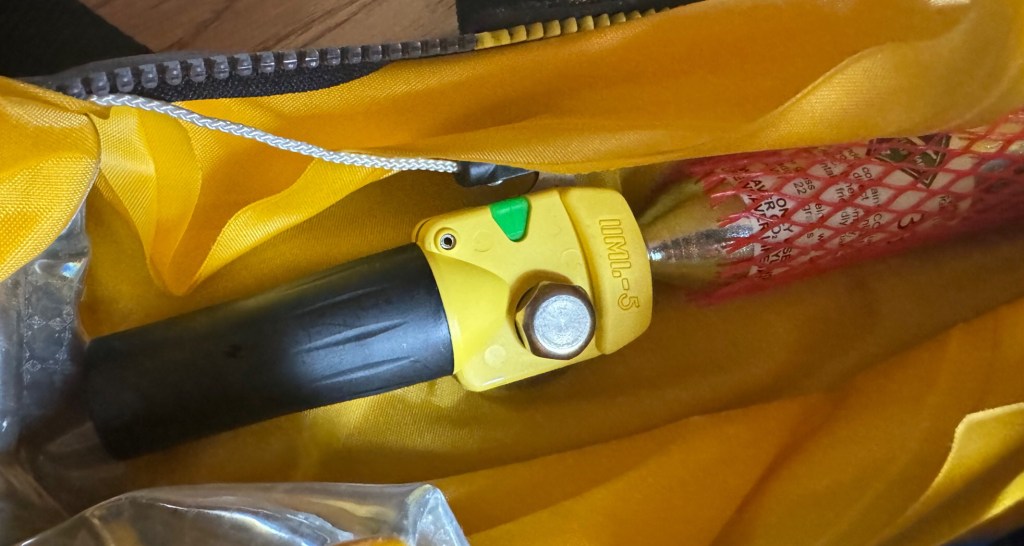
So on rivers we do usually wear light life jackets that would automatically inflate if we fell in the water. Unfortunately I found out this week that they might not work. I read an article on a boaters’ update that told me that the water detector has a relatively short life of just a few years and then need replacing. I also discovered that they can set themselves off where there is condensation in the air over winter.
So I checked our life jackets and found that both water detectors were out of date, and one also needed a new compressed gas bottle.
The good news is that replacing these is neither difficult or expensive, but it was still quite a shock to find that things we were confidently thinking could save our lives may well have failed when we needed them.
We have been boating for many many years but we are very much still learning. Every day is a school day, and this lesson could well save a life.
One of our favourite places on the UK canal network are the “curly wurlys” near East Marton on the Leeds Liverpool Canal. The canal winds around many hillsides, following the contours, so it takes forever to get a small distance, but with fine views in all directions across the Yorkshire Dales it is very beautiful. This week we moored up for a couple of days on an isolated stretch here, where we could enjoy the countryside and chill out.
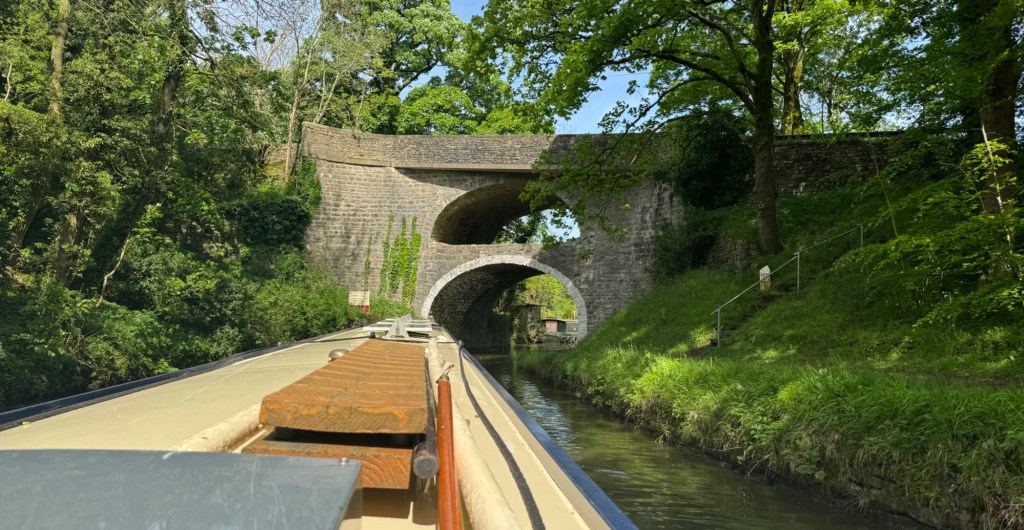
Just before the curly wurlys we passed through this double bridge, famous to narrowboaters, There is many a furrowed brow as people try to work out why two bridges are needed. Perhaps the tall bridge was collapsing in on itself and needed bracing with the lower arch? Perhaps the lower bridge once carried pedestrians at the same time as vehicles travelled across the top?
The truth is sadly more boring. The lower bridge is the original and in the 1790s was used for packhorses crossing the Pennines. When the main road was built (now the A59) the engineers built it on an embankment to cross this part of Lancashire , and so needed the bridge to be higher. The cheapest way was simply to build on top of the existing structure.
It is typical of our narrowboat journey that in a few days we can go from industrial town to beautiful nature, with a bit of history to make it even more interesting. Are you just a little jealous?











 Pete's Blog