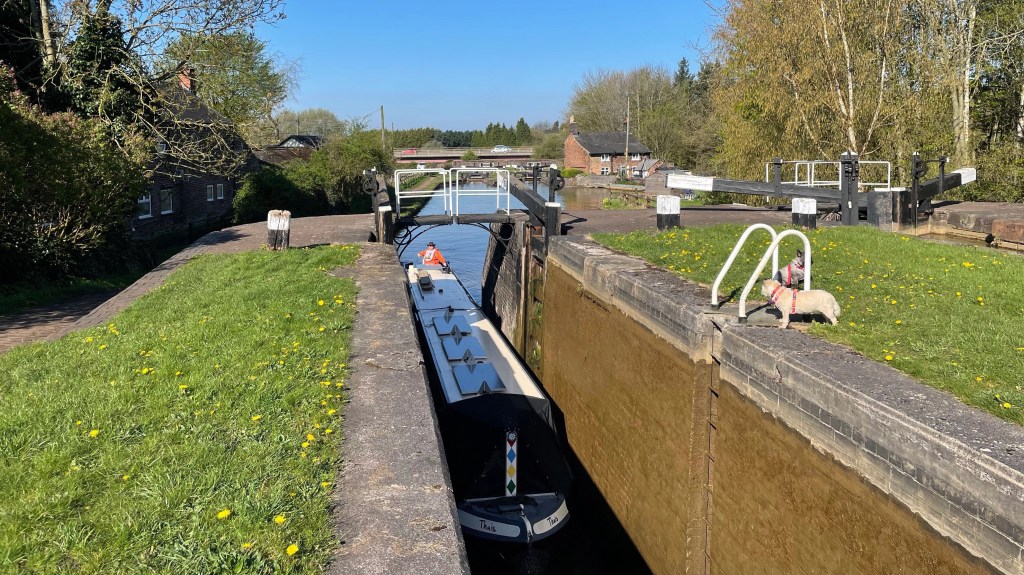
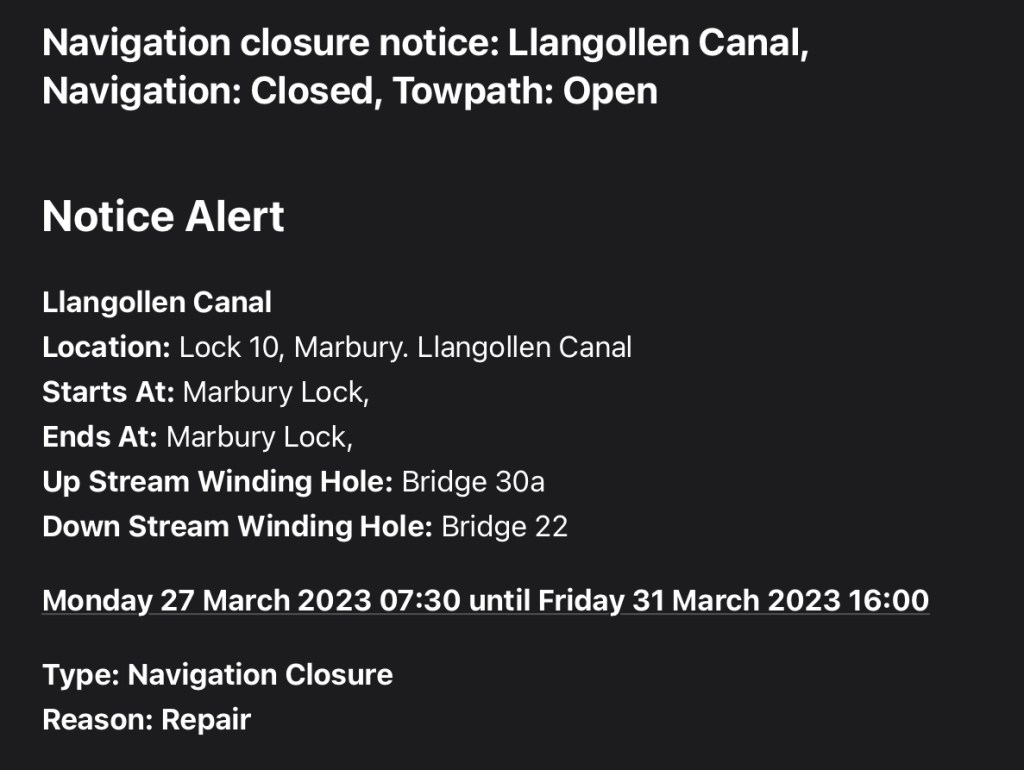
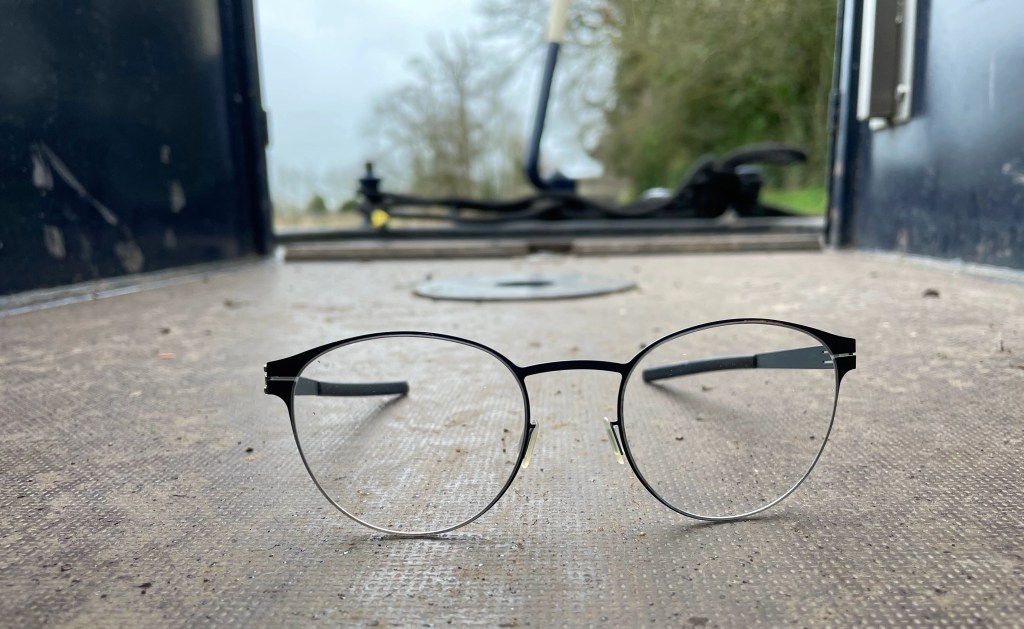
We are now properly set off for our 2023 narrowboat adventure. Our first canal is the Llangollen, one of the prettiest navigations in the UK. It gets extremely busy during the summer, so an early season visit makes sense. The weather has been a bit drizzly, but nothing we can’t cope with, and the scenery is beautiful. But on our first day out (Wednesday) I made the massive mistake of dropping my glasses in the canal.
These are expensive glasses and the only pair I have on the boat, so as they sank under the water, more than a few expletives came from my mouth. Fortunately we were just mooring at the time, so I knew pretty much where they had gone in. Unfortunately, my magnet fishing line did not find them – possibly no steel in the frames. I was not willing to give up, so I stripped down to my underwear and a T Shirt, and got in.
Boy it was cold, but I was determined, and after about ten minutes feeling along the silt with my feet, I discovered something that could be what I wanted, so I dipped under the water to pick up whatever it was – and it was my glasses!
A hot shower and fresh clothes, and a wash of my glasses and everything turned out well. No scratches, on me or the specs. I realise I was fortunate, and am grateful everything turned out well. Lesson learnt – don’t wear glasses when playing with ropes over the rear of a boat.
Have you ever lost and found something important? How did you feel?
It has been convenient to live in a house over winter. Easy to keep clean. Things don’t break as often. Plenty of space. But I have missed the boat.
The new kitchen was finally finished on Tuesday, so I drove down Wednesday with a car full of everything we need for a season – clothes, towels, crockery, cutlery, bedding. I am very pleased with the work the boat yard have done and they have kept the boat relatively tidy. Last year I had to clean lots of mould from surfaces. But this year a quick steam clean of the floor, a wipe of the insides of the cupboards, and we are fine. I have learnt that the key is to allow plenty of air circulation, so moving the bed away from the wall, having several windows open a little, and giving everything a good clean before we leave the boat in the autumn. All these things have helped.
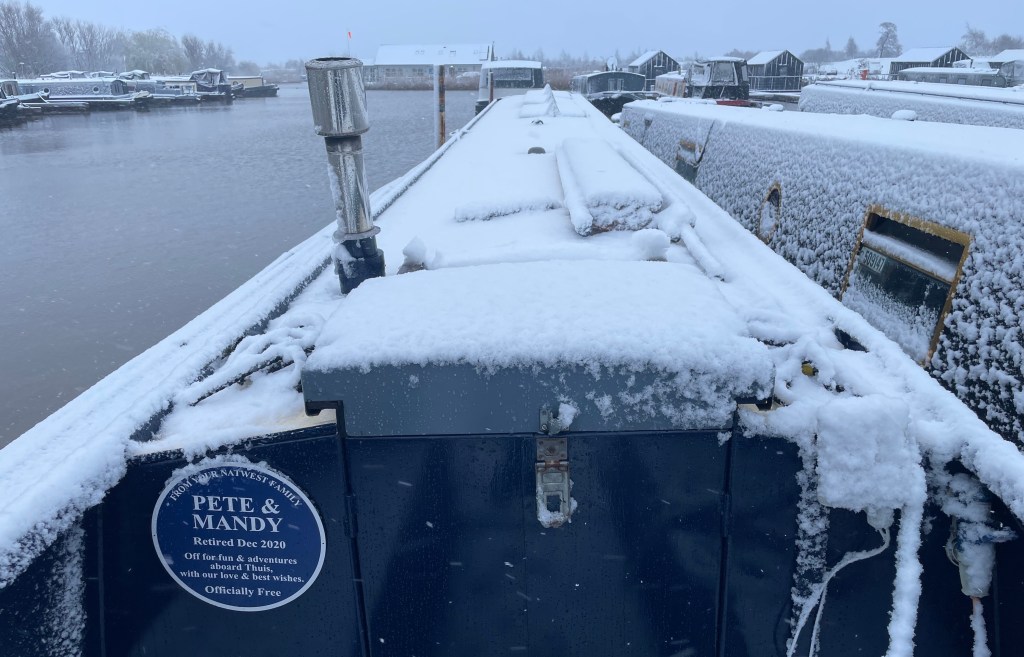
I’m heading back to Scotland later, and then will return with Mandy and the dogs over the weekend. My plan was to get going early next week, with our first trip on the Lllangollen and Montgomery canals through Wales. But the forecast is that the current snow and sleet will continue all week, so I will have to do some pretty fancy negotiating to persuade Mandy that it is better to travel than to hunker down with the cozy stove in the boat.
Gongoozlers (people who like to watch the boats but don’t have one) often ask me if it is cold living on a narrowboat. You might think so because there is just a single metal skin and little insulation. But in fact they are very easy to keep warm and do not use much energy because there is such a small airspace inside. As I write this, it is lovely to watch the snow falling outside while feeling cozy and warm inside, with the boat very gently rocking in the wind.
But I have a list of jobs to be done. I would like to give the kitchen walls a quick coat of paint to make them look as fresh as the new units for when Mandy arrives.
I was hoping that this week’s blog would be about my return to the narrowboat, after having a new kitchen fitted over winter. I know the washing machine has not yet arrived but that is not urgent, and I really want to get the boat set up for the summer season. Unfortunately I found out on Wednesday that the new cooker is installed but is not yet converted to bottled gas, so I would have no way of making food or boiling a kettle. The limited electricity on a boat means that things like electric kettles and microwaves are rarely used.
The new kitchen – work in progress
I am hoping that on Monday the new “jets” will be installed and I can travel down to the boat on Tuesday. I am bracing myself because I have not been on the boat since November, so something is sure to be broken. But we have plans for travelling the west of England this year, so the sooner I get back, the sooner we can resolve any issues and get going.
Last year we travelled for seven months, all around the South of England. This year we plan a more mixed summer, where we travel for 5-6 weeks and then return to the house for 1-2 weeks before repeating. That way we can keep the house in good order, and still make the most of the boat. It will also help us work around some events this year, such as my niece’s wedding and a weekend at the London E-Prix (Formula 1 for electric cars).
On the boat we also have targets – to spend time around Gloucester docks, to see our younger son in Tewkesbury, to cross the Pontcysyllt Aqueduct and navigate the recently reopened stretch of the Montgomery canal. I also want to return to the boat museum in Ellesmere Port, and possibly to explore the many canals of Birmingham.
So hopefully by next week’s blog I will be back… We will see.
I am getting excited now as we get nearer to returning to our narrowboat and travelling around the British canals this summer. We have been having work done on the boat including a new kitchen, but that should be ready soon, so hopefully by the end of the month we will be back.
The UK canal and river network is extensive – some 2000 miles – travelling through vast tracts of countryside, and connecting most towns & cities. Before the railways it was the best and fastest way of carrying goods from place to place, and despite falling into disrepair in the first half of the twentieth century, most of the navigations (the official name) are now open to traffic again. Volunteers and the Canal & River Trust keep the waters clear and the locks operating. It is somewhat easier than other countries because most of the equipment is self service and we can take our narrowboat anywhere we like, whenever we like.
Just a few of my guides
So of course that begs the question of how we know where to go. The answer is a mixture between 21st and 19th century technologies. There are some great apps and websites. One of our favourites is “Canal Plan AC” website, which is brilliant at working out how long it will take us to make a journey, and where likely stops are along the way. It takes account of fast and slow navigations, and time to get through locks, as well as how many hours a day we want to travel, and where are good places to moor. The other app on my phone is “Open Canal Map” which allows me to track our journey live and zoom in and out of the canal maps, for instance to see where a water point is, or a recent stoppage.
But I have to admit, despite the advantages of technology, I prefer to use proper paper books. There are two sets of canal books in common use in the UK – the Nicholson Guides and the Pearson Guides. Pearsons are more chatty and have simplified maps. Nicholsons are more comprehensive and have the detailed Ordnance Survey maps. Both guides have been around for over 50 years and are updated every few years. I had always thought that was done by hundreds of editors but by coincidence we have become friends with Jonathan Mosse, who lives on a boat near us in Scotland, and does most of the work to keep Nicholson guides up to date. When he started in the 1970s, he would spend his days boating and cycling along canals. These days he can do a lot of the research online, but he is still always grateful for updates from boaters like ourselves, who travel the canals every day, and can let him know when a bridge number has changed or a pub has closed.
This week, he kindly sent me the guides that have been updated for 2023 – covering the North West of England. They are shiny and new but it will not take long till they are covered in muddy thumb prints and hand marked updates. I feel privileged to play a small part in keeping everyone informed as we share the navigations.
If you have never had a narrowboat holiday in the UK, I recommend it. The slow pace of life will bring mindfulness and calm, even if just for a week. And don’t forget to get a copy of your local guides.
This week we are back at the narrowboat, moored in a marina near Chester. The weather is very autumnal – strong winds and rain. So we are not travelling. We have the warm stove on, are watching Christmas movies and walking the dogs.
You may wonder what the point is in coming to the boat of we aren’t travelling. Well I don’t really understand why, but when we arrive we immediately relax. Even the dogs find a comfy spot and curl up. Years ago we used to part-own a static caravan and that had much the same feel. It is as if all the worries of the world are left at home and we can chill.
Some canal boaters never move their boats. I heard this week of a new “wide beam” coming to this marina, which is too wide to travel through the bridges from here, so will be marooned. The owners don’t care. They just like staying on the water. The marina owners also recently installed five floating pods which can be hired by anyone. They are booked out at weekends, even at this time of year.
So I do get it. And I am really enjoying this week. But I confess that a little part of me can’t wait till the spring, when we will be off on our travels again. It’s like people that enjoy cruise ships. Some just want to stay on the ship. Others enjoy the facilities but want to see new things, meet new people.
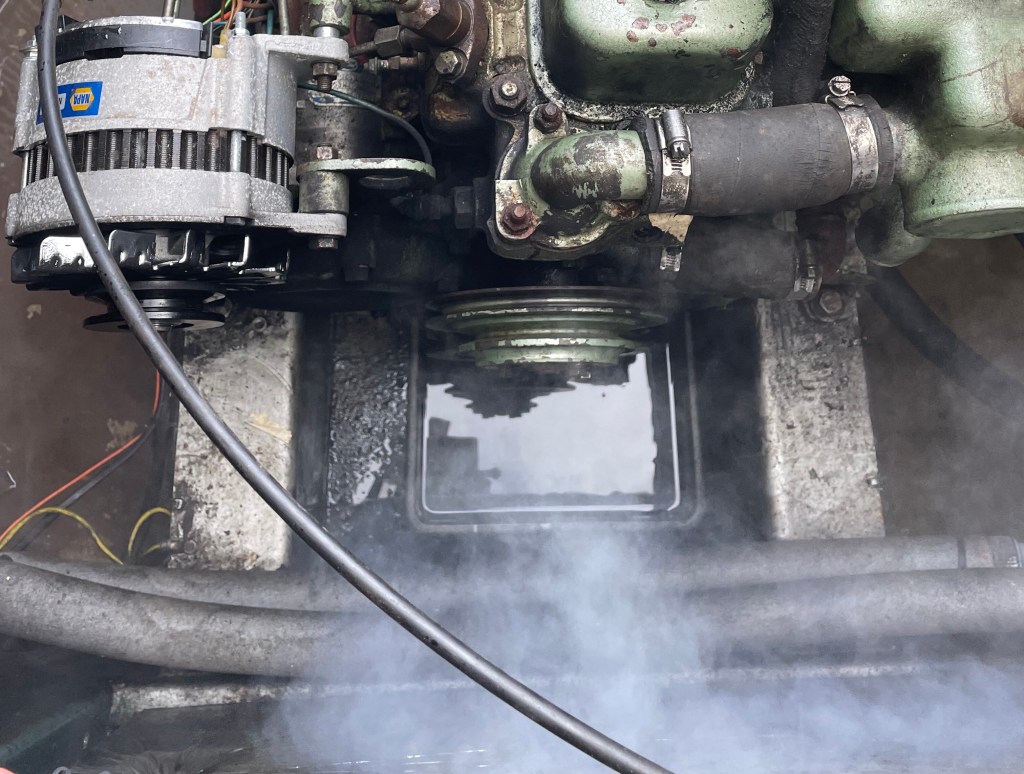
It has been cold this week – around 3°C. Unfortunately our boiler broke down – no heating and no hot water. Fortunately we have a service contract and so were able to call an engineer out. Unfortunately his temporary fix only lasted overnight. Fortunately we have a wood burning stove. Unfortunately it is not working very well because the chimney has not been swept for four years. Fortunately, with new kindling and some TLC we have managed to light it. Unfortunately it does not heat the water or the radiators.
Error 43 – no continuous flame
When we are in the house we get very used to utilities always working. You turn on a switch and the lights come on, open a tap and there is fresh clean water, click on your phone and the Internet is available. And without thinking the house is warm when it needs to be, and you can have a shower whenever you like. It is all very easy and when something does not work we get resentful, angry, confused.
It is very different on the narrowboat. There are three ways to heat the boat – the engine, a diesel stove or the Webasto boiler. The reason there are three ways is that often one or two ways are broken or inconvenient to use. The electricity is always on our mind. The solar is great in the summer but not in the dark, cloudy winters. The engine charges the batteries well but only easily when we are travelling. There is a mains hook up where we are moored in a marina, but we have to remember to top it up, or we will be cut off. And water is not always available. We have to remember to find a working canalside tap every couple of days to fill up, and once a year to disinfect the tank. As to the Internet, things are massively better than even a few years ago. We have a mobile powered WiFi router and can also tether to either of our phones which we have deliberately contracted with different networks, to maximise coverage. But it ain’t “always on”.
I wonder, is it better to have the ease and comfort of living in a house, with the consequent panic when something does fail. Or to live off grid on a boat, where it is harder work, but you understand it better. I’m not sure. I just know I don’t like being cold.
Fortunately the engineer is back today with lots of spare parts. And if that does not work, we can go back to the boat.
What is your view? Perhaps you believe that with sufficient layers of clothes, we do not need heating?
While we have been travelling on the narrowboat over the past two years we got to visit a lot of friends and family we had not seen since lockdown. But there were a few we missed out so this week we set off on a road trip. I am writing this in a cozy pub hotel near Stratford on Avon. This morning we are off to Hove in Sussex to see one of our sons. Then from there we travel to Surrey to stay with our sister in law, and then on to a vast mansion on the south Devon coast, where some friends are house sitting. From there it is to the far end of Cornwall, to stay at the Pig Hotel, where our other son is working. Back via Salisbury to see my Mum, and then to a village near Cambridge where Mandy’s Aunt lives. Finally we stay with Mandy’s brother in Lancashire and then home to Scotland via our friends in the Yorkshire Dales.
It will be quite an adventure and a good run out for our new car. Our old Qashqai had served us well for five years but was costing us more to maintain than it was worth, so after much prevaricating we have opted for a 2019 Kia Sportage. It is absolutely fine to drive but petrol heads will be disappointed that the main criteria for purchase were space in the boot for our dogs’ crate, and lots of “toys” inside like sat nav, apple play, parking camera. Immediately after signing for the car, I felt a bit of post purchase dissonance – would an XC40 have been more sensible, could I have negotiated a better deal, would a 2020 model have been better? But now we have had it for a few days, I am happy. It will do us very nicely.
Some of the route aligns with canals we have traversed this year. Journeys that took us several weeks in the boat are completed in a few hours. I prefer boating because you see so much more on the way but I admit I am enjoying being able to go left and right as well as straight on, as we do on a canal. When we see friends from the boat, they sometimes suggest meeting at some pub in the countryside, and we have to point out that the narrowboat is not great across land!
So on with the trip. It may not be Route 66, or even the Highlands North Coast 500, which we enjoyed a few years ago, but I am excited. I quite enjoy this retirement lark.
Last weekend we spent a couple of days at a very special mooring. Ellesmere Port is a run down small industrial town, on the south bank of the river Mersey and next to the Manchester Ship Canal. It does not have much to commend it, but it does have one gem. It is home to the National Waterways Museum. The old port is at the end of the Shropshire Union canal, where is meets the ship canal to the sea. It was once a thriving area, employing hundreds of people loading and unloading goods. After years of neglect, in the 1970’s a group of volunteers got together to clean it up and turn it into a boat museum. They did an amazing job and today it houses several acres of old buildings, exhibitions, boats and history. And best of all, we got to moor overnight in the middle of it.
We stayed for a couple of nights, and during the day got to visit all the exhibits and look around the town. But even better, in the evenings, the staff locked up the museum gates and we were left all alone. We had a special key so we could get in and out, but I loved wandering around the museum with the dogs, taking a close up look at the old terraced houses, the heavy port equipment, the boats themselves. It was kind of spooky although I did not see any ghosts. I could, however, imagine the dock workers busy in the docks, and the boat owners, living in their tiny cabins, behind a large barge full of coal or grain.
We are nearing the end of our six month narrowboat trip for this year, and this was a great experience to add to the memories. A night at the museum may not have been quite like in the movies but it was something very special nevertheless.
This week we took the Shropshire Union canal down into Chester, an ancient city that grew up from a Roman garrison settlement called Deva. The Romans built it here because it was roughly in the middle of the area of the UK they had conquered, it had good Roman road connections, and at the time it had good access to the sea through the river Dee. After the Romans, it continued as a successful medieval port city, and the Normans developed it further with a castle, a large cathedral and extended city walls.
Along the city walls, overlooking the canal.
These walls are possibly what Chester is most famous for. I walked a couple of times all the way around them, there are fine views across the countryside up to the Wirral and down to Wales. You can look down on Chester racecourse. You can see the Roman amphitheatre and ruined columns in a garden. The north side has the canal running alongside, utilising what once would have been a moat.
We moored up in a basin near the city centre, and just across from Telford’s Warehouse, a large pub, based in the headquarters of Thomas Telford, who built this canal. We had a fine meal with excellent craft beers, and even more excellent company of two of our nieces and a new boyfriend, who had to undergo a full inquisition from me and Mandy, testing for suitability. He passed!
The weather has turned this week and it has become wet autumn. But we have slowed down our travelling as we near the end of our summer on the boat, so a bit of rain can usually be avoided. And that has given more time for visiting Chester. Next year we plan to do a little less travelling and a little more visiting. Perhaps after two years, we are realising that retirement is more a marathon than a sprint.
As I have travelled the world I have been in many bars, but have never found anything quite like a British pub. There are caricature “Irish Pubs” in many a city, but they just aren’t quite the same. Perhaps it is the inclement British weather that means we desire cosiness and that is what is different. Perhaps it is our unusual taste for warm beer. But today let me tell you about my favourite pub.
The Anchor Inn, High Offley, Shropshire
In 1987 we were on one of our first narrowboat holidays, doing the Four Counties Ring with friends. We stopped one night in the middle of nowhere and came across this pub, the Anchor Inn. The postal address is High Offley, a little village in Shropshire, but in reality it sits by itself, next to the canal. Presumably it was a farmhouse that started serving drinks when the canal was built, around 1830.
Although it looks reasonably large on the photo, the pub itself is just two small front rooms in the house. When we first found it, all drinks were fetched from the cellar. Nowadays they have electricity and chilled lager and cider on tap, but if you want a pint of real ale or scrumpy, they still go down into the cool cellar to get it.
Since 1987, we have visited maybe ten times. It is far too out of the way to be a regular haunt. But a few times making a special effort driving, and of course whenever we travel the Shropshire Union Canal, we go to see if it has changed. Sadly, Olive, the landlady for over 50 years, passed away last year. But her daughter has taken over and it is just the same. This week, the conversation in the pub was all about narrowboating. Where have we been this year? What have we seen? And the Wadworth’s 6X was served perfectly.
I know that over the years British pubs have had to change to survive. Most now serve good food, and have light, airy spaces. I do like those pubs. But sometimes it is nice to find favourites that have not changed, and the Anchor is one of them,.