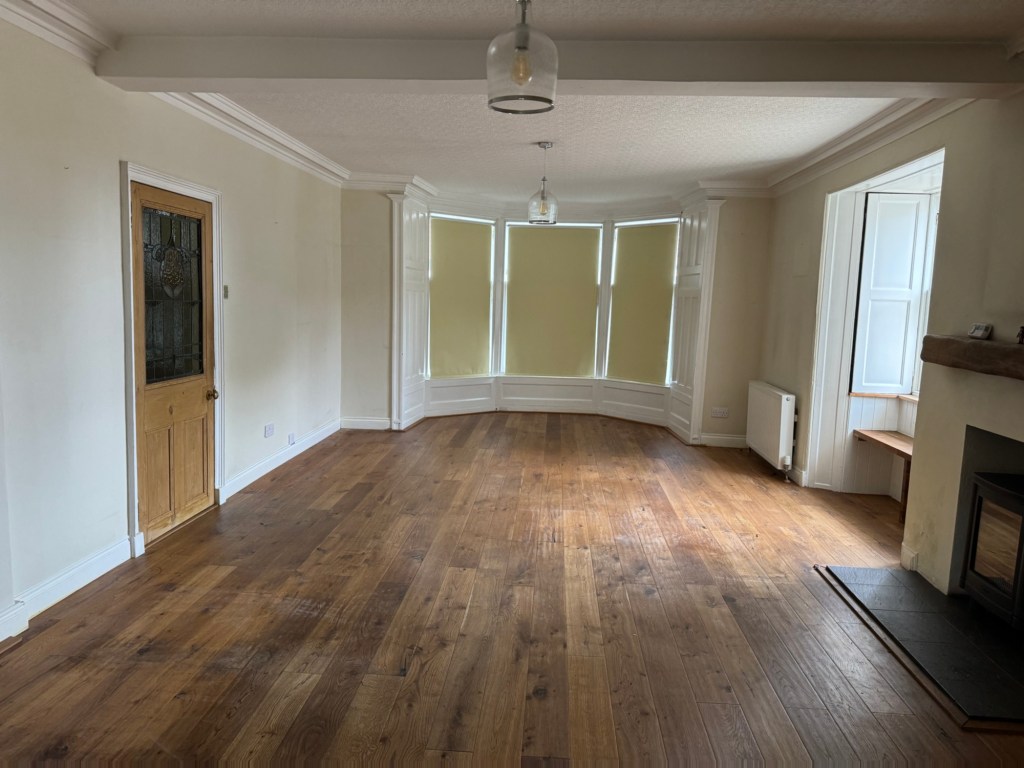
By the time this blog is published, we will be houseless. After nearly two years on the market our house in Scotland should complete its sale today and will have new owners – a lovely family who will get to enjoy the history of this nineteenth century farmhouse which became swallowed by a new town in the shale oil revolution around 1900.
I deliberately use the word “houseless” not “homeless” because we still have a home on our narrowboat. Dictionaries define “home” as simply the house where you live, but I think it means more. You know you are home when you sit down with a happy sigh. It is the place where you feel most comfortable and most safe. So much more than a house.
And when we arrived back at the boat last night we immediately felt at home. It just feels so right to be here. Putting all our stuff into storage this week has been pretty stressful. It has also reminded me how over the years we have collected things that we really don’t need. We are no happier in a house surrounded by chattels than we are in the boat where we have very little.
We do still want a house as a base for winters, and for the future when we can no longer operate locks or moveable bridges. Next week we will be staying with our eldest son and his fiancée near Brighton. We are looking forward to seeing them and their new home. And when we then return to the boat, we will properly start our house hunt.
But for now it is great to be home on Narrowboat Thuis. Entirely appropriately “Thuis” is Dutch for “home”.
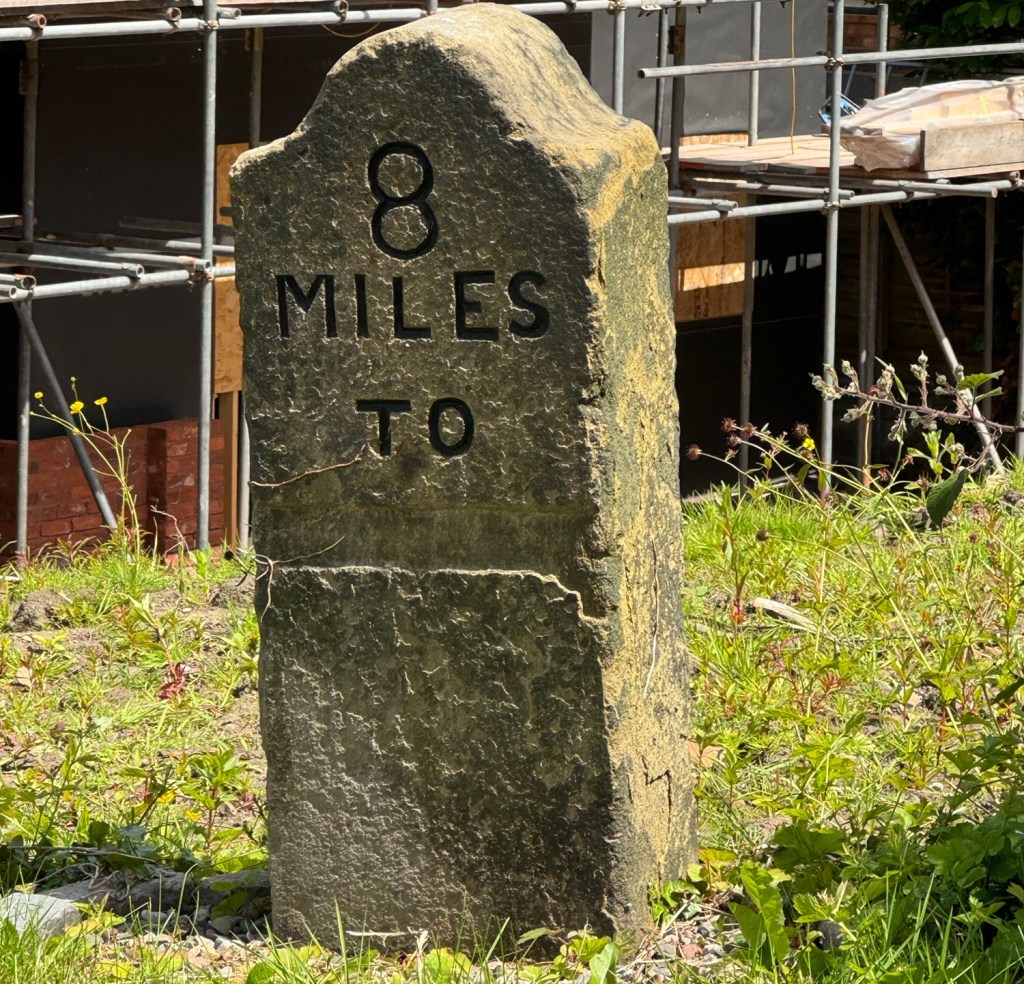
This milestone is next to Marple locks on the Peak Forest Canal. I like it because it represents much of our life on a narrowboat. We travel. We see places. We plan our routes. But ultimately we have no destination. It is the journey we enjoy. That is so different to travelling in a car, where the destination is everything, and the journey is just about getting there.
And by enjoying the journey, we discover more. This week we have found wonderful moorings, just avoided big delays from closures, and been on adventures.
Starting with the adventures, I walked along a long old tramway that used to carry limestone from the Peak District down to the canal. I had a day out in Buxton, the highest town in England with history back to the Romans. And I walked to the foot of the Marple Aqueduct, the highest stone aqueduct in the UK.
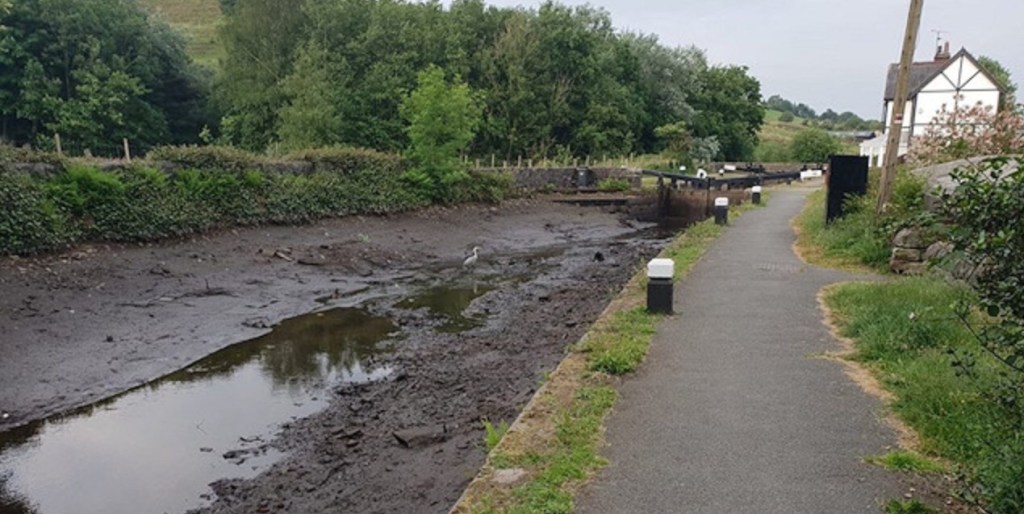
The canal stoppages included a whole stretch of the Macclesfield canal which is currently closed due to the canal leaking. This is extremely serious because not only could it cause flooding of nearby land, but it could also lead to the whole of the canal draining and leaving us boaters marooned. We also found ourselves stopped halfway up the Marple lock flight, when a “pound” between two locks had drained due to a paddle being left up. And when the lock keepers let more water down to help us, the water flooded a brand new house that has been built next to the flight while it has been closed for the past ten months. Someone will need a word with that surveyor!
And we stayed at two of my most favourite moorings on the whole canal network. Bugsworth basin is like a dock at the end of the Peak Forest Canal, near Whaley Bridge, with space for up to forty narrowboats. Originally it would have been used to transship the limestone from the tramway onto boats to carry around the country. These days it is full of wild flowers and geese. So it has a dramatic mixture of old ruins and nature. Also a very good pub.
My other favourite mooring is further up that canal on an isolated stretch, with an incredible view down into the valley at a village called Strines. Apart from the occasional hiker or cyclist we have the place to ourselves, and it is just so very chilled. A beautiful midpoint on our journey to nowhere.
We have spent the week travelling the Leeds and Liverpool canal across West Lancashire, finishing up in Reedley Marina, near Burnley. We have moored in a marina because it is a safe place to leave the boat while we spend ten days back up in Scotland. Despite spending more than half the year living on our narrowboat, we still own a house for the winter months and have returned to get a few jobs done. I have a dental appointment, a blood test and a big birthday to celebrate.
Narrowboat Thuis in Reedley Marins
Arriving back at the house has made me think of the five things I prefer, living in bricks and mortar to on the water:
1. A house is so much bigger. On a boat we have to think carefully before acquiring anything because the space is so limited
2. Our house has a bath. The shower on the boat is great and after a day’s boating the water is toasty warm, but I do like a long soak in the evening.
3. When things break it is usually less catastrophic. There are things I need to fix around the house but they are not critical. When I reversed the narrowboat into a wall this week, the rudder was knocked from the “cup” it sits in and the whole boat became unsteerable. Fortunately my son Martin was with us, and jumped into the canal to reseat it.
4. We have a car in the drive. When we are on our long cruises we don’t use our car because it is simply too difficult to keep moving the car to be near the boat. This may be better for the environment, but it does make things more difficult when we need to get anywhere away from the canal.
5. The full fibre broadband to our house is super fast. We do like to have fast internet, for browsing or streaming. On the boat we have three different mobile networks on our phones and the wifi router to try to make sure we have good access, but sometimes in cuttings and out of town, it can be a problem.
There are also good reasons that living on a narrowboat is better than living in a house.
1. Life on a boat is simpler. We don’t have so much “stuff” and we have learnt that we don’t need it. We shop locally. We talk about simple things such as where we are going tomorrow, and what to have for tea.
2. The views are stunning. Our house is on a Main Street with road noise. Our boat can be in a different mooring every day, Last week we passed through some pretty run down industrial canals in Blackburn and Burnley, but we still found one of the prettiest moorings between the two towns, on an embankment, next to a golf course, with incredible views across to the Pennines.
3. Exercise is part of our lives. We don’t have to think about needing to go to the gym or for a run. After 21 locks, we are pretty exhausted and it feels good.
4. The dogs are more settled. Lulu in particular, runs around the house sniffing at walls and barking at pigeons. On the boat she just jumps onto the sofa next to Mandy, and cuddles.
5. The community on the canals and rivers is more friendly. We have good neighbours in Scotland, but travelling along, locking together or just meeting people on the towpath, everyone wants to help, everyone has a story to tell. By nature I am pretty antisocial, but not when we are on the boat.
I guess we are very lucky to have the house and a narrowboat. But if I had to choose, I would choose living on a boat. It is a good life.
On a canal, the length of water between two locks is called a “pound”. On a lock flight this might be three or four boat lengths long. Sometimes it might be shorter. There is a pound on the Staffs & Worcester canal that is just a few feet long (there is a side pound where all the water goes when you empty the top lock). There are “long pounds” on canals that are very flat. For instance last week we had a forty mile pound on the Bridgewater.
Once or twice a year we find a pound is empty. Last year there was a mile long empty pound near Gloucester after a hire boater went through the bottom lock one evening and left all the paddles up. The year before we grounded in a pound overnight on the Aylesbury canal because of leaky lock gates. This week we have faced three separate empty pounds. The first was about a mile long in Wigan, caused by vandals. The second was about half a mile on the Rufford arm, caused by a lazy boater leaving paddles up. The third was a short planned “dewatering” by the Canal & River Trust (CRT) in order to inspect blocked culverts.
So what do you need when faced by an empty pound? The first and most obvious thing is a lot of water. Somehow you need to fill the canal back up to at least four feet in depth. If you think the canal is maybe twenty feet wide, and the pound is maybe half a mile long, that is an awful lot of water. You have to bring that water down from higher in the canal, maybe using bywaters that go around some locks, and sometimes by opening paddles on the locks themselves.
The second thing you need is time. You need to fill that water without draining the pounds higher up. For this reason, CRT prefer the work to be done by their staff rather than boaters. A short pound may take just an hour or two to fill, but the Wigan and Rufford problems this week took a day each.
The third thing you may need is special equipment. On our boat we carry a windlass to open lock paddles, a CRT key to open water points and swing bridges, and an anti-vandal key to open the handcuff locks used to prevent bad people causing trouble. CRT staff can remove other padlocks and open special paddles to let in water from other sources such as rivers and reservoirs. Again this has to be done very carefully to prevent flooding.
By far the most important thing you need is patience. There is no point getting cross about what has happened. It won’t help. There is no point trying to get through before the water has fully filled, because you will get stuck. Instead, we just wait it out, and look for the best. In Wigan I found a nice local butcher that I would have missed. In Rufford we just moored up and watched a couple of films.
If you are in a hurry on a narrowboat, you have chosen the wrong lifestyle. We are lucky enough to be retired. For us, narrowboating is not just about the wonderful places we go. It is about the journey to get there – however long that takes.
And we’re off! We have made several short trips already this year, but this week we set off on our narrowboat for the next six months. This is our fourth year since retirement and our fourth year of boating all summer. The first year was in the North of England, the second in the South. Last year we travelled the westerly canals and rivers – Shropshire Union, Llangollen, Montgomery, Trent and Mersey, Macclesfield, Peak Forest, Staffordshire and Worcester, River Severn, Gloucester and Sharpness, River Avon, Stratford, Birmingham and Fazeley, Coventry and Ashby canals.
The obvious thing would be to head east this year, but the canal network is not so good on that side of the country so we have decided to complete a few more of the canals we have not travelled before, while picking up some of our “greatest hits”.
This week we journeyed up from our winter base in Stone, through the very long Harecastle Tunnel, and down 25 locks of heartbreak hill in a day. We are now travelling through the very flat and very beautiful Cheshire Plain. Over the next six months we plan to moor in Liverpool docks, cross the Pennines on the curly wurlys, travel through the Happy Valley, revisit the history of Bugsworth Basin and maybe go on a steam train next to the Caldon Canal. From there our plans are more fluid and that is part of the adventure.
People often ask us how we cope living in such a confined space for six months. Sometimes we see hire boaters having massive rows as they are not used to being on top of each other even for a week. But Mandy, the dogs and I have found our happy rhythm. We don’t try to go too far each day. We empathise when someone makes a mistake driving the boat – we all do it. I am happy for Mandy to sit in a quiet corner doing her cross stitch. She is happy for me to dash off to find a stately home or a roman fort.
I think we are very privileged to enjoy this life and am really looking forward to the next six months. I love retirement.
We stayed this week at Tixall Wide. This is one of the loveliest moorings on the British canal network. Most canals are just wide enough for two boats to pass. Digging more would have been a waste of money. But when the Staffordshire and Worcester Canal was built, a rich landowner, Thomas Clifford, would only let the canal cross his land if it was dug to look like a lake, fitting in with his gardens that had recently been developed by famous gardener Capability Brown.
Narrowboat Thuis moored in Tixall Wide this week
Tixall Wide is really very beautiful and because of that gets very full. During peak season you need to arrive in the morning or you stand little chance of getting a space to moor. Even in the winter it is pretty full because it is a good place to wait out the cold weather, in walking distance of Great Haywood junction where you can get water and a bit of shopping.
But this time of year is the best to get a great mooring. Most of the winter moorers have moved on or are in marinas, and the hire boat season has not yet started. We were extra lucky this year because Tixall Wide had work done on a drainage culvert over winter, and so was not open to anyone. So this week we were moored with just three other boats. It was wonderfully quiet, and properly dark at night, with no light pollution. The moon and stars seemed so bright.
It is the earliest in the year that we have been travelling on the narrowboat since I retired and in all honesty, it is a little too cold and wet when steering the boat. In a few weeks it will be warmer and more civilised. But the big benefit is the peace. And when we are sitting in the boat with the stove keeping us toasty warm, it is a lovely place to be.
I am naturally positive. My instinct is always to see the best out of everything and to look for opportunities in adversity. Indeed, when I was working I would sometimes be criticised because I would not spend enough time on “what went wrong?” because I was always looking for “what can we do now?”.
But even positive people occasionally have bad days, and Wednesday was one of them for me.
Two things went badly wrong. The first was the dentist. I had an appointment for a crown replacement, but my new dentist took one look and told me I have bigger problems. Apparently I grind my teeth at night and they have worn down to a level where the back teeth are rubbing against each other and putting pressure on the side of the crown which was why it had split off. Fixing could cost thousands of pounds which I don’t have. In the meantime he put in a temporary crown and left me in a lot of pain as the anaesthetic wore off.
Then just as I was feeling down, my phone rang. It was the couple who are buying our house. At least they were. Their buyer had just fallen through so while they still want our house, our planned date of March 22nd is now impossible, which means the house we were buying in Lancashire is also off.
So no house and in pain. Not my best day. Mandy also understandably angry and upset. So what to do?
Normally my response would be to switch on my positive energy and find five great reasons to be happy about the day. It would probably have irritated all those around me but it would have made me feel good. But for once it was not what I wanted to do. I just wanted to wallow in my miserableness. I found a quite corner and read a book.
So now it is two days later and and I am very much back to myself. There are lots of good things that will come out of this. My teeth are fine – for now at least. We get to stay in Scotland longer. I will even get my 60th birthday Scottish bus pass. And if the Lancashire house falls through, there will be another one, Fate is our friend.
I have also decided – sometimes even the most positive of people is allowed a bad day.
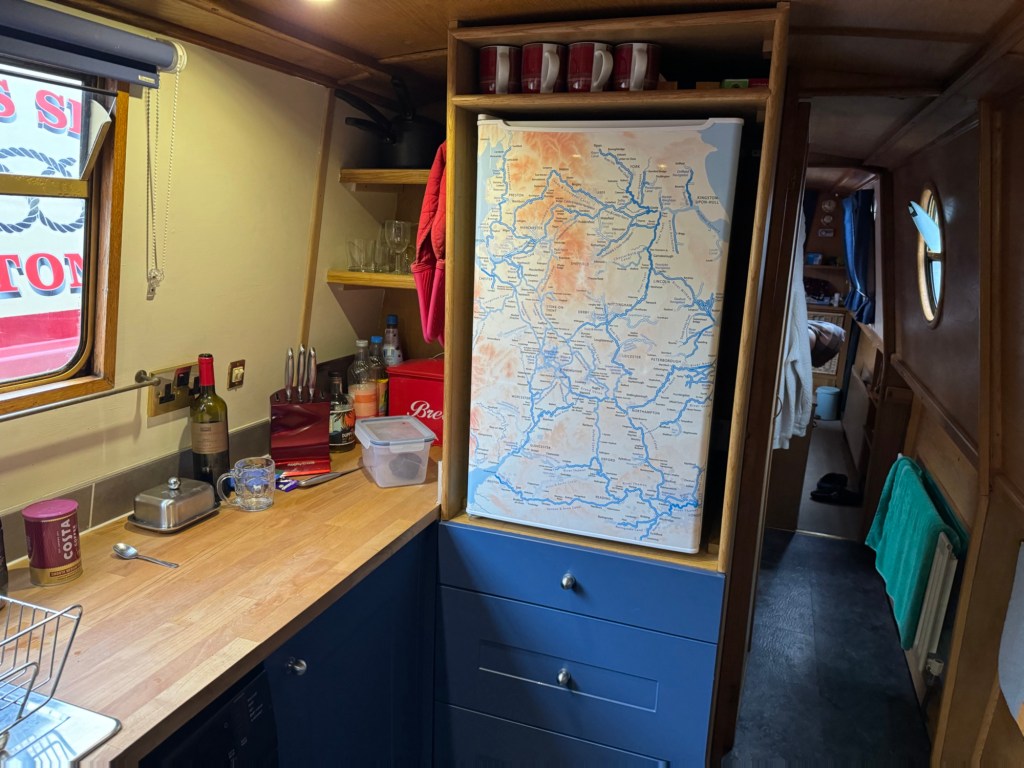
From March to October we are continuous cruisers on our narrowboat. We travel around the country seeing new places and meeting new people – having new adventures. We are already planning our first trip for this year, probably heading up to Liverpool and then crossing the Pennines to Leeds. I am excited at the thought and this week I made a boat improvement that will help – a map on the fridge.
We had the kitchen upgraded before last season and we have been very happy with it. The one thing we did not like was the white fridge, which did not look quite right. So I had a vinyl “wrap” made of the canal network and have put that on the door. Now, not only does the kitchen look better, but we can easily show visitors where we have travelled and where we are heading.
This is an example of the sorts of “jobs” I tend to do over winter, when the boat is moored in a marina. The experience of staying on a boat when it is not moving is different from our summer adventures. We are not seeing new places every day, and we are not enjoying the loneliness of staying overnight somewhere away from everyone. But there are advantages too.
The marina has plenty of facilities including electricity and water on the pontoon, toilets, showers, pump out, and even its own pub. We also have access to our car so I can easily get to shops or go to see people. I also really love the cold weather. Gongoozelers (non boaters) often ask if the boat is too cold in the winter. The answer is absolutely not. We have central heating from a diesel boiler, and a “bubble stove” that easily heats the small airspace in the narrowboat. Last night for instance was icy cold outside, but Mandy and I were in our T shirts and had to turn the stove off because it was over 24°C in the boat.
It is cold in the mornings because we tend not to have the heating on overnight, but it is cozy warm in our bed, and the boat doesn’t take too long to warm up. I also really love getting up to take the dogs for their first walk, and seeing the early morning sun glinting off the frost and ice on the boats in the marina. It is very beautiful.
Staying on a boat that does not move is a different experience than our summer adventures. But it has its own charms. I am just so happy to be back on the boat.
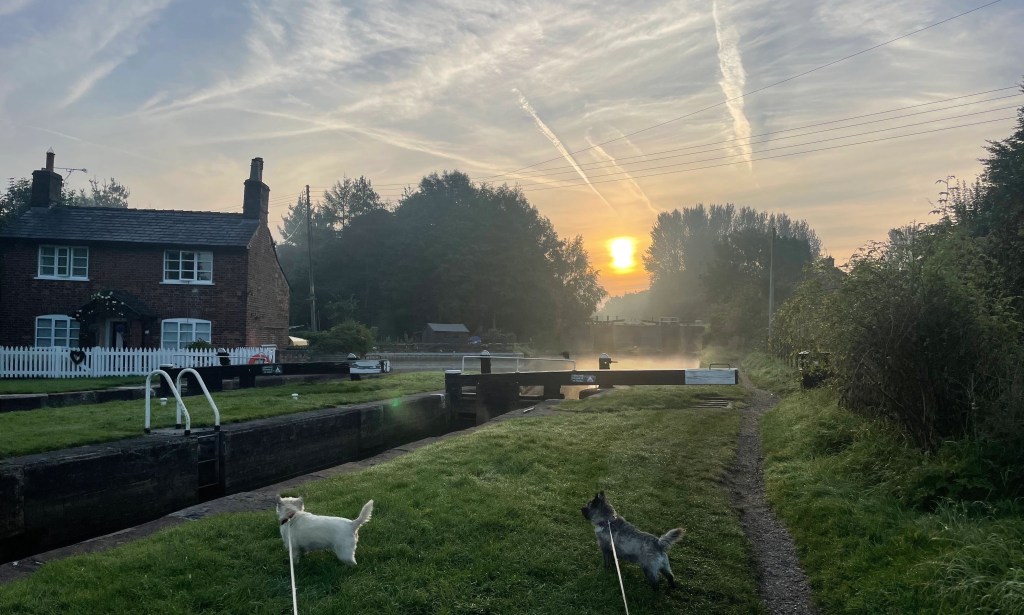
In the UK we have had something of a heatwave this week, with plenty of sunshine and warm temperatures. At the same time the days are getting shorter and I have often woken to mist rising off the canal in the dawn sunshine.
I feel as if such “Indian Summers” are increasingly common, before Autumn sets in, and they provide some of the best days on a narrowboat. The plants are still in full bloom with some just beginning to change colour. The water fowl still have plenty of food and swim happily around the boat. The canals are busy with experienced boaters on hire boats taking advantage of reduced prices after the school holidays. Everyone seems content.
And there are always surprises. On Wednesday evening we were moored outside Chester and went for a bite to eat and a pint in the Cheshire Cat pub, quite a famous boaters’ inn. The food and beer was good and instead of canned music we were treated to songs from a local ukulele band.
They “interpreted” many popular songs. This might sound terrible but after a long hot day on the boat it was genuinely just what I wanted.
We only have a few more weeks cruising this year but right now we are loving every moment. September is a great time to be on a narrowboat.
One of the reasons we love narrowboating is the amazing scenery we see. I do enjoy the old industrial warehouses and mills, but there is something special about finding beautiful countryside with the canal meandering through it.
This week we travelled down the Coventry Canal to join the Ashby, an isolated canal in the midlands. Originally it was used to bring coal from the local mines and was probably filthy, but that industry is long gone and the water is now clear. The countryside is mostly fields with wide views from the boat. It is one of the most beautiful waterways we have travelled.
But perhaps not the most beautiful of all. There are the “curly wurlys” west of Skipton on the Leeds Liverpool. High up in the Pennines and winding around the hills. There are the final few miles of the Caldon to Froghall, in a stunning wooded cutting, with a steam railway for company. There are the Llangollen and the Montgomery, providing a great mixture of winding round the contours of Wales, and cutting through tunnels and over aqueducts. The Sharpness was a revelation for us this year. Straight and wide with great views over to the River Severn. All of these are wonderful but I think the prettiest of all would be the Peak Forest. The Peak District is one of the most dramatic National Parks in the UK, and this canal skirts the edges of high hills, with views for miles.
We are just so lucky to be have the chance in retirement to discover such great countryside.
Do you have a different view of the prettiest waterway in the UK?










 Pete's Blog